Monolith
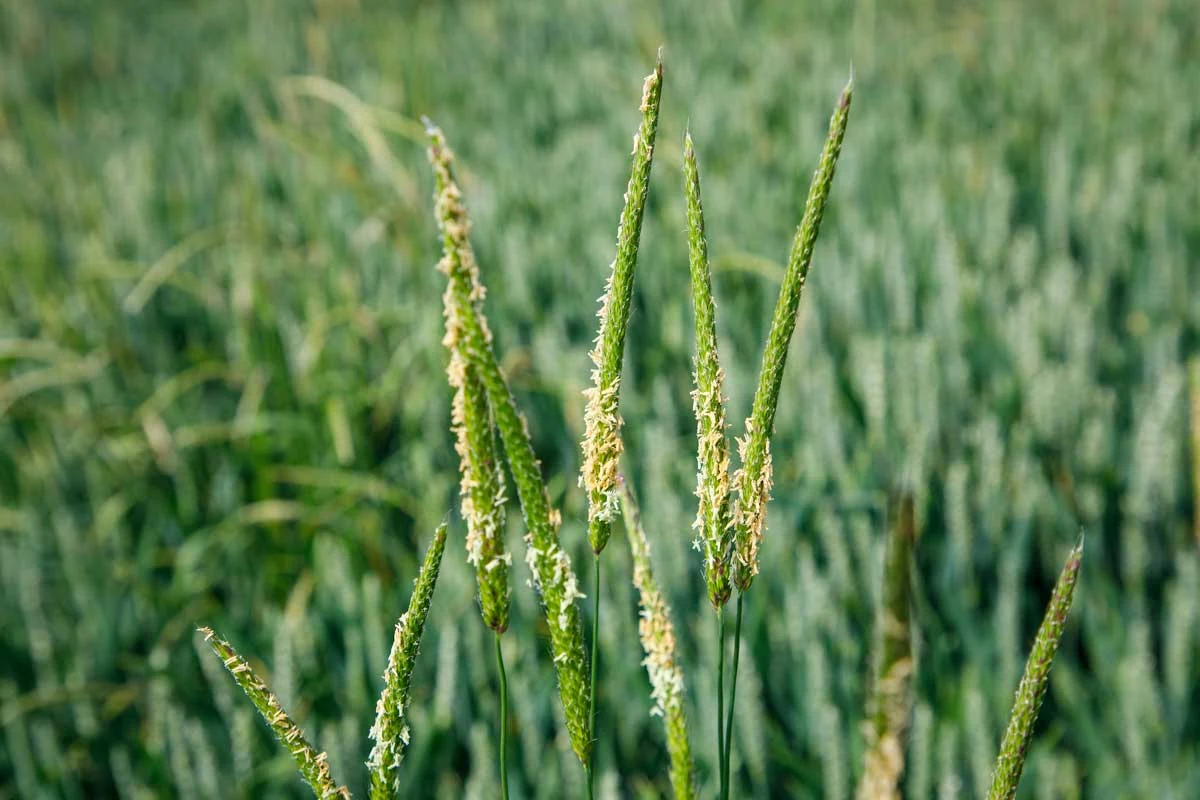
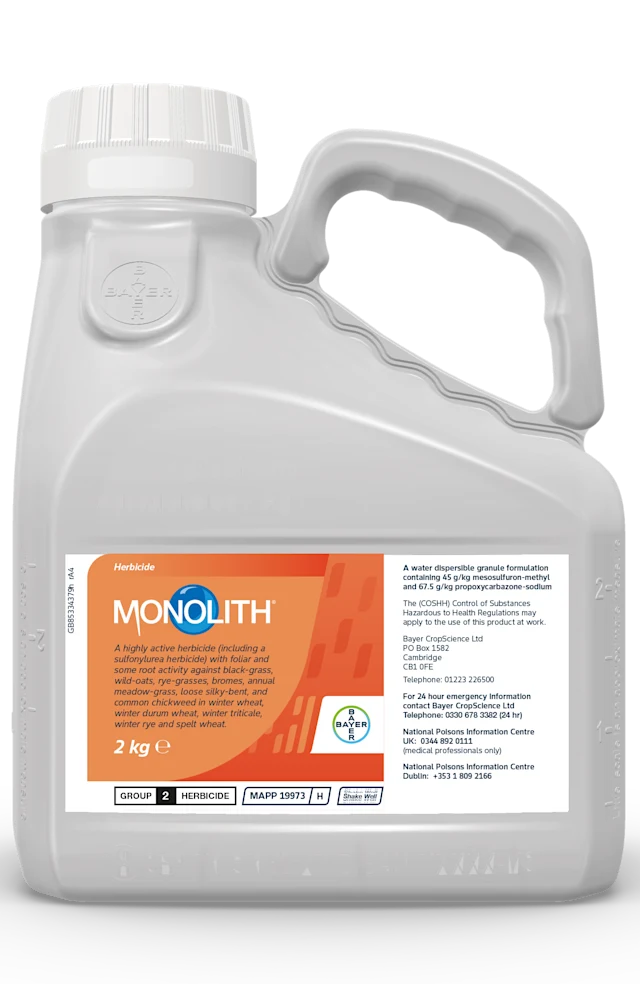
Monolith is a post-emergence herbicide for control of black grass and brome species in winter cereals when applied in the spring. It is a specialist solution offering strong control of brome populations.
Product details
Monolith is a post-emergence herbicide for control of black grass and brome species in winter cereals when applied in the spring. It is a specialist solution offering strong control of brome populations. It partners two actives with exceptional grassweed activity- mesosulfuron and propoxycarbazone.
Monolith is the final stage of a black-grass control programme following on from cultural controls and a robust pre-em. Use Monolith in spring from the 1 February and when the crop is at 3-leaf stage until 2nd node detectable (GS12–32).
Uptake is mainly through the shoots so there needs to be some active growth for the herbicide to take effect; care is needed for applications in February when conditions may be cold. Weather conditions at application are very important; apply to a dry leaf with sufficient drying time before dew forms.
Like other Bayer post-ems, applying Monolith when the target weed is small increases the overall level of control but conditions need to be right. Applying in cold or wet conditions is not advisable even if the plant is small because the active substances will not be taken in effectively.
It is often said that the control from herbicides is 50% chemistry and 50% application and Monolith is no exception. The aim is to land the herbicide on the target leaf so it settles, dries and is taken in by the plant. To do this a fine spray, possibly fine-medium is required. Generally, the flat fan type nozzle produces a finer spray than the air inclusion nozzle.
Forward speeds should be no more than 12 km/h and make sure the sprayer boom remains stable to get a consistent application. Water volumes of 200 L/ha are suitable for Monolith.
All applications should include 1 L/ha of the adjuvant biopower. There is also the option to include 0.3 L/ha Liberator as residual protection if you are expecting further spring germination of grass-weeds.
Propoxycarbazone is a highly effective active ingredient for controlling several key brome species, including sterile, great, meadow and rye brome. When combined with mesosulfuron in Monolith, it forms a specialist spring-applied solution for brome control.
Whilst Monolith is effective on grass weeds, it is at the expense of some activity on broad-leved weeds so make sure you consult the label before making the switch from other mesosulfuron + iodosulfuron based products as an alternative purpose spring herbicide.
Is it effective against resistant black grass?
Monolith is based on mesosulfuron the same main active in Atlantis OD, so it won’t transform the situation with resistant populations. However, the co-formulation with propoxycarbazone does offer a potential uplift in control in even in some situations of metabolic resistance. In an integrated weed management situation, and cultural controls are effective, Monolith can help provide control of black grass.
Will it control brome and other grass weeds?
Monolith is a specialist brome product. Year after year in trials such as Bayer Crop Science’s Chishill weedscreen in Cambridgeshire, Monolith will give class leading control of brome species including Sterile, Great, Rye and Meadow. Growers should always use an integrated weed management system with regards to reducing brome species populations. Monolith is a valuable add on tool to help the overall weed strategy.
Will the strong activity affect my crops this year or next season?
It is right to consider crop effects on any herbicides with strong grass-weed activity like Monolith. In season, the level of crop safety is equivalent to Atlantis OD i.e. safe if the label guidance is followed. For following crops, winter oilseed rape requires deep cultivation if Monolith is used.
What can I tank mix with Monolith?
Simple tank mixes with just Monolith + biopower and a residual partner if necessary give the best results but workloads mean that is not always possible. Applications with T0 or T1 is the main concern in early spring so pay attention to the fact that mixes with tebuconazole are not supported due to crop safety and antagonism respectively. Consult the tank mix guidance sheet for more details.
* Also approved where the following crop is either an autumn drilled cereal crop or any spring crop.
** Maximum rate 0.1 L/ha