Five tips for growers in the west to consider in September
Tom Astill highlights five agronomy areas for growers in the west to consider in September

Posted 4 years ago
30/08/2022
Tom Astill highlights five agronomy areas for growers in the west to consider in September
Harvest has generally been early, dry and pleasing. Winter wheat yields have been average to above average, although some spring cereal yields were disappointing after being dependent on moisture at establishment and grain fill. The hot weather also caused pod abortion on spring beans.
Maize is variable. In the north-west where there has been more rain it’s looking generally well, but it’s struggling more in areas that didn’t get much moisture through July and August. Rainfall has been variable across the area I cover from Leicestershire to Lancashire.
Moisture is more important for oilseed rape establishment than drilling date. While reducing soil temperatures and day length hours reduce the opportunity for the crop to develop a bigger canopy pre-winter, it’s not too late to establish oilseed rape in the first half of September.
With the hot, dry July and first part of August, especially, there could well be more September-established oilseed rape this season than for several.
Where there is still more to plant, all the same factors still apply for early to mid-September establishment – primarily you’re looking for rapid germination and emergence.
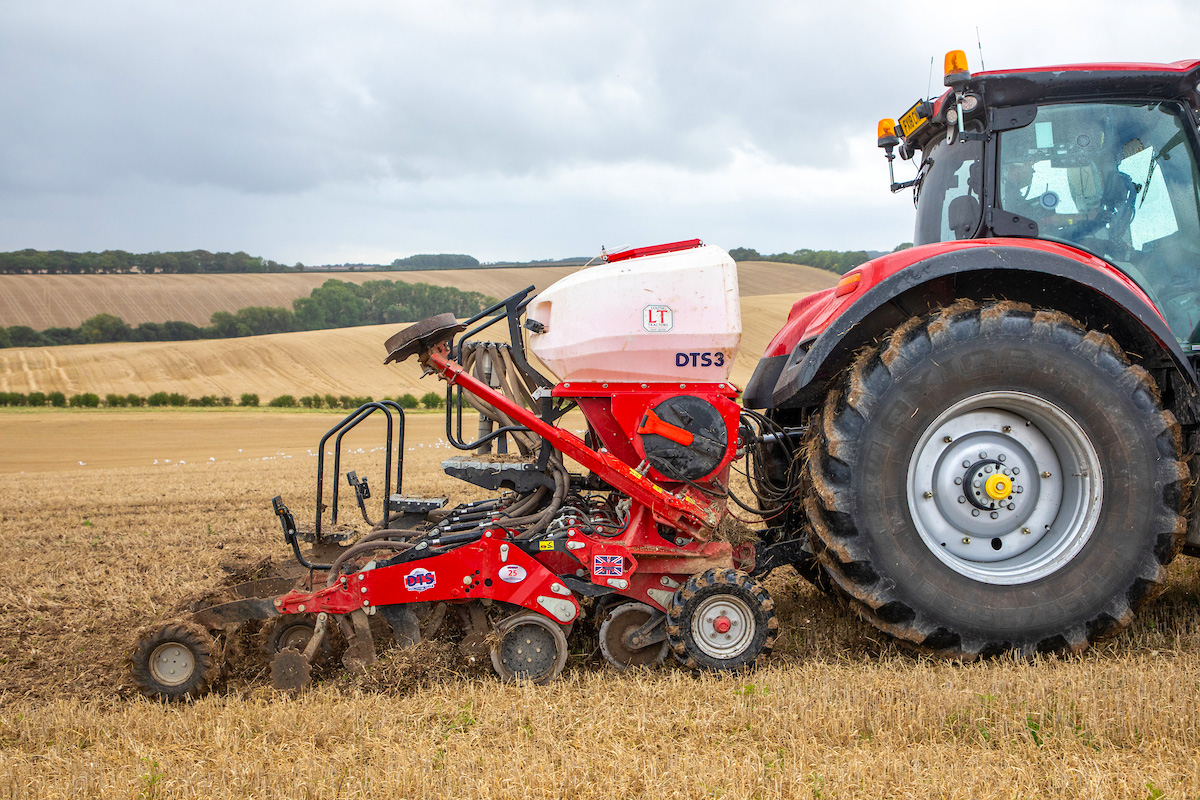
For that you need moisture so conserving it regardless of method of establishment is important. If possible, with the farming system I’d recommend some form of reduced tillage. Direct drilling will also help reduce the green / brown contrast which we know cabbage stem flea beetle use.
Rolling post-drilling to consolidate seedbeds, especially if you have used cultivations, can also help increase seed to soil contact, conserve moisture and disrupt slugs.
Seedbed nutrition or manures are important so that plant growth is not limited by lack of nutrition.
September can be a little late to establish some species of companion crops, but they’re still worth considering.
Be careful with seed rates – it can be false economy to use a lot of seed. Your optimum plant population in the spring is 25-40 plants / sqm. Larval loads of cabbage stem flea beetle will be the same per plant regardless of seed rate, so you can have the same number of larvae in thinner stems with higher seed rates.
Our seed brand Dekalb has a range of varieties to suit any system and requirements, whether it is for specialist agronomic issues such as Clearfield herbicide tolerance or club root, or more general requirements of rapid germination and good disease resistance. Visit our website to find out more about our varieties and the Dekalb establishment scheme.
Stubble management depends on lots of different factors including soil type, state of soil structure, preceding crop, following crop, and weed species and burden.
Flexibility in approach is key. From a weed management perspective, different weed species require different strategies. If you have a mixed population of weeds, as most fields do, then work out which one is going to be the priority.
Black-grass and Italian ryegrass are like to germinate quickly this autumn once we have moisture – dormancy is likely to be low following the summer weather. I’d look to keep seed on the surface initially to make use of any weathering or predation. But once there has been some rain a shallow cultivation will help get seed to soil contact and into moisture to encourage a chit. Don’t create too fine seedbed as it can go like a pudding if we get significant rain.
If there has been very high seed return, consider using the plough as a rotational tool to bury seeds to reset the field population.
For bromes management depends on the species. Sterile and great brome can be managed similarly to black-grass with a shallow cultivation as dormancy is broken by covering the seed with soil.
Meadow, soft and rye bromes need a month on the surface to ripen before a shallow cultivation to cover to break dormancy. In high pressure you might be better using the plough.
Wild oats should be left on the surface for predation if you can, as these can germinate from depth and seed is viable for many years.
When it comes to spraying off emerged grassweeds with Roundup (glyphosate) follow the Weed Resistance Action Group’s guidelines to manage the risk of resistance. Rates should be a minimum of 540g a.i./ha for two to three leaves, rising to 720g a.i./ha for tillering weeds.
With the dry weather there may only be time for one chit of weeds this autumn, so if you’re only planning to spray once go as close to drilling as possible. If the initial chit is such that two sprays are required, which is the maximum number that should be applied for stale seedbeds (according to the WRAG guidelines), then make sure some form of mechanical cultivation is used in between sprays to remove any survivors from the initial application.
Where difficult grassweed pressure is likely to be high, consider growing a spring crop with an overwinter cover crop. Ideally this would have been planted in August, but the dry weather may have made that difficult. September drilled cover crops can still work, although species choice might be more limited. Once you get into later September, it might be getting a bit late to get the full benefit from a cover crop.
Winter barley drilling usually starts in late September. With fewer post-emergence options available in winter barley than winter wheat, grassweed control can be challenging, with the pre-emergence residual at least as important as in winter wheat.
After the introduction of the metribuzin active into winter barley in Octavian MET and Alternator MET (both flufenacet + diflufenican + metribuzin), this year the approval for Proclus (aclonifen) has been extended into the crop, offering another new active for growers to potentially use.
As in wheat use Proclus in combination with Liberator (flufenacet + diflufenican) at pre-emergence only, but note the rate of Proclus is 1.0 L/ha for winter barley compared with 1.4 L/ha for winter wheat. A key determinant of crop safety is drilling depth so make sure seeds are covered with a minimum of 32mm of soil and apply as soon after drilling as possible – ideally within 48 hours.
Liberator + Proclus is the better option for difficult to control populations of grassweeds, while in easier situations the metribuzin-containing products are an option. Alternator Met or Octavian Met can be used at 1.0 L/ha until the end of September and then 0.5 L/ha up to the end of November. They also have the advantage of being post-emergence as well as pre-emergence.
In difficult grassweed situations drilling of winter wheat should be delayed into October, if a spring crop isn’t being grown, to give maximum opportunity to take out emerged grassweeds ahead of drilling.
But where drilled in September the same products and advice about applying withing 48 hours of drilling remain.
Potato crops have gone backwards in the August heat, particularly the non-irrigated ones. Some have started to senesce.
The hot and humid weather has also increased pressure from both early blight (Alternaria) and late blight. Where Alternaria is popping up, Caligula (fluopyram + prothioconazole) is a good option with activity against both Alternaria alternata and solani.
In late season protecting tubers from blight increases in importance, and that might be even more critical this season as yields could be lower and quality specification challenging. Potato prices are likely to increase as a result.
Keep using products with tuber blight activity as crops head to burn down. Infinito (propamocarb + fluopicolide) with its excellent zoospore activity is one such option.
Where you are considering using home-saved seed in cereals, test it for the main seed-borne diseases, such as loose smut, leaf stripe, Microdochium, bunts and net blotch. Where tolerances are exceeded fungicidal seed dressing should be used to protect crops.
Bayer seed treatments provide broad-spectrum protection from most of the seed borne diseases. Redigo Pro (prothioconazole + tebuconazole) can be applied to winter wheat and barley, and Raxil Star (prothioconazole + tebuconazole + fluopyram) to winter barley.