6 insights into keeping crops healthy this June in the west
Gareth Bubb talks through six agronomic decisions to keep crops on track this June in the west.

Posted 5 years ago
28/05/2021
Gareth Bubb talks through six agronomic decisions to keep crops on track this June in the west.
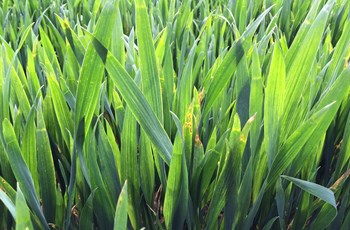
After just 22mm rain in March and 21mm in April, in May we’ve had 120mm in just three weeks in the west. That’s helped wheat crops pick up nitrogen, and they’ve tillered out and are looking green and healthy.
Septoria, as we approach the end of May, is only visible at the bottom of the canopy, mostly on leaf five, occasionally on leaf four, while yellow rust is coming back in on susceptible varieties three to four weeks after T1s were applied, even where strong yellow rust chemistry has been used.
If it goes very warm you can’t discount brown rust becoming a problem.
While oilseed rape crops are variable again, there is definitely more better looking oilseed rape crops than last year.
Despite the rain, our rapid disease detection service, which assesses latent Septoria and yellow rust infections in wheat leaves, is coming back with very low levels of disease. That’s partly due to the low rainfall in March and April, and the cool temperatures meaning the diseases are not cycling very quickly.
That doesn’t mean you don’t need to put any fungicide on, but it does mean that hopefully T2s are likely to be more protectant than curative. That could also mean you don’t need to spend on the most expensive new chemistry.
Flag leaf emergence has been slow, but in most cases T1s were applied quite late too so in most cases the gap between the two should still be three to four weeks. Don’t be tempted to stretch that longer to five to six weeks to try and do a combined T2 and T3, as that will put everything under pressure. When it warms up things are likely to change quite quickly, so well-timed sprays with shorter intervals are the backbone of the programme.
On later sown, less susceptible varieties T2 sprays can be based around 1.0 L/ha of Ascra (bixafen + fluopyram + prothioconazole), but in the majority 1.2 L/ha should be used. If it’s an early sown, more susceptible variety and timings have been extended then that can be increased further to 1.5 L/ha or use one of the alternative new products.
Crops this season could rush through growth stages as soon as there is warmth, meaning the gap between T2 and T3 could be even narrower than usual.
But remember what you’re trying to do at both timings – the T2 is all about protecting those upper leaves from disease, while T3 is primarily controlling ear diseases, with a secondary aim of topping up foliar disease control. Don’t compromise either or both timings trying to make life easier.
There’s usually a narrow window for correctly timing ear sprays for Fusarium control – the ideal timing is early to mid-flowering. To get the best control of Fusarium you need around 150g/ha of prothioconazole.
This season there’s an opportunity to use Aviator (bixafen + prothioconazole) at T3, if you haven’t used two SDHIs within the programme by this stage. With high grain prices, you don’t want any loss of yield even in feed wheat, and every day you can keep the crop greener is increasing yield. If you’re on good soils that hold onto moisture, there could be a justification for using the SDHI at T3.
Where two SDHIs have already been applied, then Proline at 0.55 L/ha is a good alternative. If brown rust is a concern then the addition of a strobilurin will help.
I’m picking up quite a bit of Rhynchosporium in spring barley over in the west, and the key this season will be to keep the interval between T1 and T2 tight.
It’s definitely worth spraying twice in spring barley this season, especially with net blotch and Rhynchosporium being quite aggressive diseases.
With the resistance issues with net blotch, keeping doses of Siltra (bixafen + prothioconazole) or Fandango (fluoxastrobin + prothioconazole) high is important. I’d start with a minimum of 0.4 L/ha of Siltra or 0.75 L/ha of Fandango.
Ramularia could be an issue – it does like wet leaves – but equally crops are not looking too stressed at the moment, which is another contributing factor. Having good doses of Siltra will help in any case, but I’m more worried about net blotch currently.
My number one bit of advice for oilseed rape desiccation is don’t go too early. As with wheat, if you can keep oilseed rape green for longer that seems to have a direct correlation on yield.
With workloads there can be a temptation to desiccate to a harvest date, but use the guidelines on how to judge when it is ready. Take a representative sample of 20 pods, and look for when the majority of the seeds have changed from green to brown to assess whether the correct spray timing of under 30% moisture has been reached.
If you go too early there is also a risk that oil content will be compromised, maturity hindered resulting in red seed.
Potato crops have been very slow to emerge in the cooler weather. If you’re still to spray pre-emergence herbicides and are using Emerger (aclonifen) do make sure the application is pre-emergence of the crop.
As the crop does start to grow away, make sure you start your blight programme early – it’s a lot more difficult to control late blight once it is in the crop.
Plan programmes carefully – there are fewer options available for tuber blight control so make sure you have left enough sprays of options, such as Infinito (fluopicolide + propamocarb) for the end of the season, as well as considering their use earlier in the season.
If you’re growing a variety like Markies, which is susceptible to early blight (Alternaria) we have a new option available in Caligula (prothioconazole + fluopyram), which will be welcome as other products have lost their approval in recent years.
Maize looked tender because of the cold weather as we approached the end of May. Be careful not to hit them too hard with herbicides while they are stressed as that could knock them back further.
I’d wait for a bit of warmth and recovery in the maize before considering applications. Unfortunately that could mean it is quite a difficult season for weed control in maize, as the weeds will be growing.