
Crops across the north are forward, thick and carrying high disease loads after a settled autumn and wet winter. Agronomists heading into April face serious cereal disease management decisions, particularly around yellow rust control, septoria suppression and stem base diseases in winter wheat and increasing net blotch pressure in barley. ATO Chris McClymont gives his honest take on what he's seeing and what to do about it.
Author
Chris McClymont | 1st April 2026Tags
Cereal Disease Management in Forward Crops
Winter Wheat & Winter Barley Crop Status and Conditions
Crops in the north are very forward and lush after near-ideal autumn drilling conditions. A wet winter has driven significant septoria infection and the shift to more settled and warmer spring weather in mid-March means yellow rust is cycling quickly. All cereal diseases are easy to find with most crops carrying multiple threats simultaneously. Therefore, strong PGR and robust fungicide programmes are not optional this season they are the foundation for protecting the yield potential these crops have built.
Top 3 Things to Watch – Winter Wheat
1. Yellow Rust
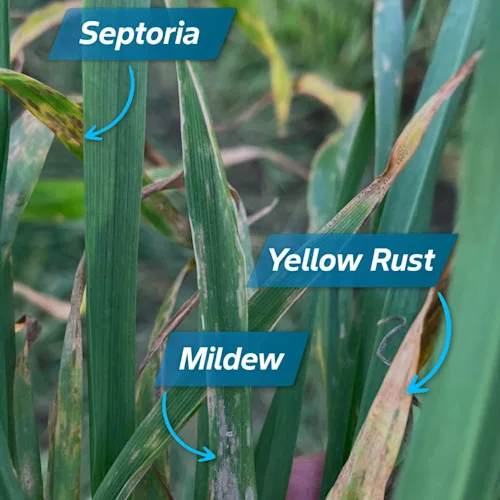
What's being seen: Active yellow rust is present across many fields of wheat with the new Yr15 strain affecting most varieties.
How widespread: The North East was the epicentre of the Yr15 breakdown in 2025 so it is likely that there will be yellow rust across the region.
Risk if no action: Yellow rust can complete a full cycle in as little as 2–3 weeks in warm spring conditions so any delay costs yield fast
Resistance / stewardship: Many T0 programmes will have been tebuconazole-based, providing useful knockdown but limited persistence; forward planning of T1 actives is essential.
Practical recommendation: A tebuconazole-based T0 should provide a solid yellow rust knockdown, but continual protection is the critical differentiator going forward. Where you judge yellow rust risk to be escalating and in most northern wheat crops this season it is, bringing in isoflucypram (Iblon®) at T1 gives both strong activity and meaningful extended protection against the disease. In the right conditions, yellow rust cycles fast; a strategy which relies on knockdown alone will not hold up this spring.
2. Septoria Tritici
What's being seen: Heavy disease on lower leaves in winter wheat driven by a wet winter and dense canopies creating micro-climates for rapid multiplication.
How widespread: Present across virtually all wheat crops in the north
Risk if no action: Septoria has a latency period of approximately 21 days - infections you cannot see yet will be working their way up the canopy during rain events or even heavy dews.
Key timing point: T1 when leaf three fully emerged on the main tiller is the most important timing in the programme; do not delay it!
Practical recommendation: Don't be distracted by disease-heavy lower leaves and chasing curative activity there, those layers will be lost regardless. The priority is protecting leaf three at T1, which calendar wise normally falls in the third to fourth week of April in the north, but early drilling and varietal growth rates differ field by field so slicing open stems is the only real way to be sure on hitting the right target. Depending on the efficacy of T0 and the time interval it is likely you need a balance of protective and all-round disease activity in your winter wheat T1 which is where Ascra® Xpro® and Plaxium® really come into their own. Delivering all-round disease control in single cans with multiple modes of action, simple trusted and reliable solution.
3. Eyespot
What's being seen: Risk is elevated in early drilled, forward, thick crops and nothing on the Recommended List has great scores currently so it is exactly the conditions that favour the eyespot species.
How widespread: Not always visibly symptomatic yet, but the risk factors are fully stacked.
Risk if no action: Eyespot causes stem weakness and lodging later in the season; by the time it's obvious, it can be too late to act effectively.
Practical recommendation: For agronomists weighing up T1 mix composition, the loading of prothioconazole in Ascra® Xpro® carries important eyespot activity alongside its septoria and rust performance. Products combining isoflucypram (Iblon®) with fluopyram and prothioconazole such as Plaxium® cover eyespot as well as improved efficacy on Septoria and yellow and brown rusts.
T1 Product Guidance – Winter Wheat
Where you decide T1 fungicide protection is justified (and with these crops, it clearly is):
Moderate pressure / moderate yield potential: Ascra® Xpro® at 1.0 L/ha is a strong starting point, bixafen + fluopyram + prothioconazole deliver on yellow rust, septoria and eyespot and have plant health boosting benefits as well.
Higher pressure / higher yield potential: Consider Ascra® Xpro® at 1.2 L/ha, or step up to Plaxium® at 1.0 L/Ha which adds isoflucypram alongside fluopyram and prothioconazole for stronger disease control think of it like “Turbo Ascra”
If you're short of spray days: Plaxium® or Ascra® Xpro® both offer the extended protection inherently in their formulations that is needed to optimise protection.
Top 3 Things to Watch – Winter Barley
1. Net Blotch
What's being seen: Beginning to appear and will become more prevalent as the season progresses; one of the most difficult barley diseases to control once established.
How widespread: Anticipated across most crops; forward, thick crops at highest risk
Risk if no action: Significant yield loss and tiller stress if unchecked
2. Brown Rust
What's being seen: Easy to find in hybrid varieties specifically; already active and present.
How widespread: Patchy but consistent across hybrid barley
Risk if no action: Brown rust cycles rapidly; yield losses compound quickly in susceptible varieties
3. Tiller Retention
What's being seen: Forward, thick crops under combined disease and canopy stress
Risk: Losing tillers means losing ear count means losing yield — head count is one of the primary yield drivers in barley
Practical note: Early fertiliser and sound T1 timing work together — don't let one slip behind the other
Practical recommendation: T1 is the most important and highest-responding timing in winter barley. Where you decide a robust input is justified, Ascra® Xpro® ay 0.9 L/Ha has a strong fit across all disease with the fluopyram component bringing particularly useful net blotch activity. Isoflucypram (Iblon®) in Plaxium® which received approval on Barley this year, covers all major barley diseases, including net blotch. Taking stress out of the crop at T1 retains tillers, protects ear count and reduces late-season lodging risk.
Oilseed Rape – Mid-Flower Spray
Crops in the north are approaching early to mid-flowering. For agronomists weighing up a mid-flower spray, Aviator® Xpro® provides protection at petal fall and tops up light leaf spot (LLS) control. The bixafen and prothioconazole combination in our Xpro formulation coat’s petals ahead of petal fall and covers stem and sclerotinia risk simultaneously.
About Chris McClymont
Chris McClymont is a Bayer Crop Science Technical Manager covering the north of England. He works closely with independent and distributor agronomists across the region, providing practical, field-level guidance on crop protection decisions in winter cereals and oilseed rape. His advice is grounded in what he's seeing on farm — not in theory.
Ascra® XPro® contains bixafen, fluopyram and prothioconazole. Plaxium® contains isoflucypram, fluopyram and prothioconazole. Iblon® is the commonly used name of isoflucypram active substance. Aviator® XPro® contains bixafen and prothioconazole. Ascra, XPro, Iblon, Plaxium and Aviator are registered trademarks of Bayer. All other brand names used are Trademarks of other manufacturers in which proprietary rights may exist.Use plant protection products safely. Always read the label and product information before use. Pay attention to the risk indications and follow the safety precautions on the label. For further information, including contact details, visit www.cropscience.bayer.co.uk or call 0808 1969522. © Bayer CropScience Limited 2026