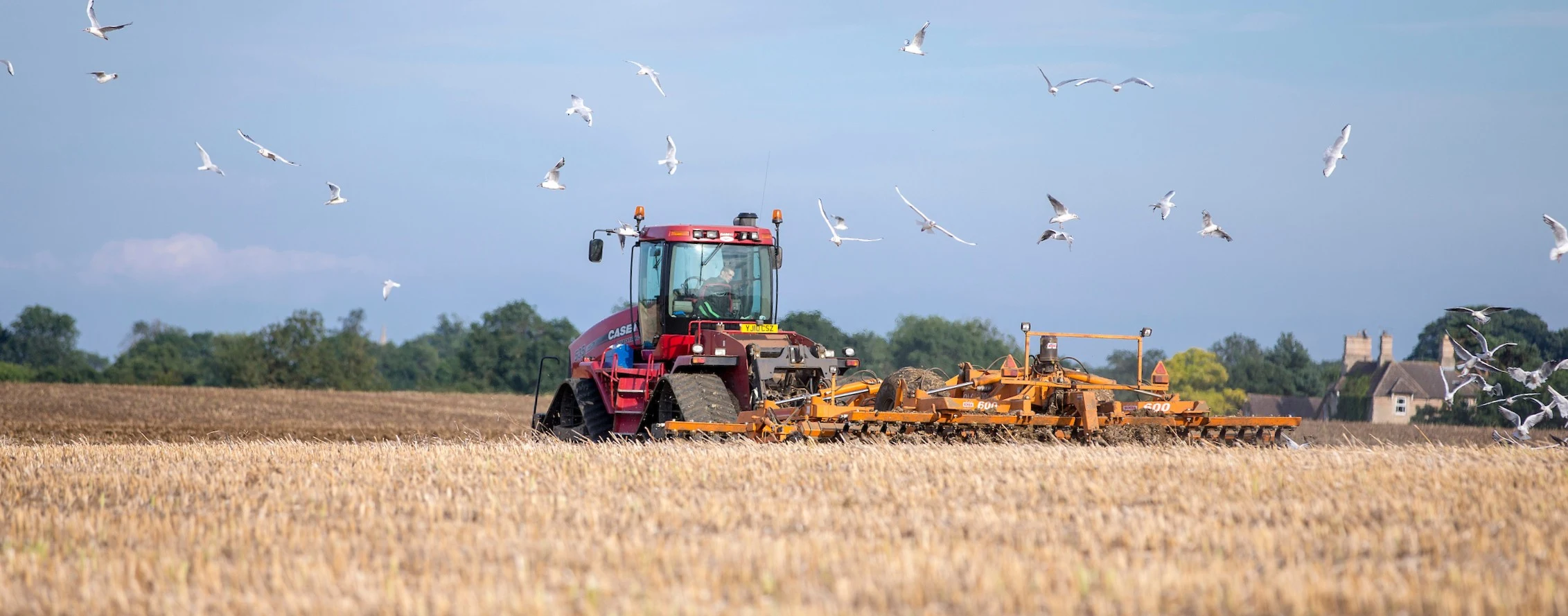
Autumn weed control is becoming more field-specific across Scotland and the North of England. Ed Scaman explains why drilling date, Italian ryegrass, brome, resistant broadleaf weeds and limited travel opportunities should shape the choice between herbicide sequences and a robust pre-emergence programme.
Author
Edward Scaman | 16th September 2026Tags
Scotland and North September Agronomy Advice: Tackling Autumn Weeds
Autumn is always a compromise up here. We need to get crops in before winter closes the door, particularly on the heavier ground, but early drilling can bring its own weed challenges.
The main message this year is to look at each field in front of you. It depends on where you are, what weeds you have in that field, what the cropping history is and when you are likely to drill. Not every field needs the kitchen sink, but where the risk is there, it needs dealing with properly.
The good news is that the recent rain has brought stubbles to life. There is a real opportunity to get weeds moving, clean them up and start the autumn programme from a better place.
Stubbles first – take the stale seedbed opportunity
Driving around Scotland, there are plenty of stubbles greening up. Brome is coming through, along with wild oats, volunteer cereals and, in places, a surprising number of volunteer potatoes.
This has probably been one of the best years for stale seedbeds. Where there is time before drilling, it makes sense to encourage a flush, then take it out before the crop goes in. If you are planning to min-till and have not had the chance to create a stale seedbed, it is well worth looking at getting Roundup® onto those stubbles now.
The key is not to let weeds become established before the crop is even drilled. Brome is often obvious in headlands, but do not overlook the rest of the field. The same goes for wild oats and volunteers. Get them cleared while they are actively growing and while the weather is still relatively warm.
Volunteer potatoes are another one to deal with. They are appearing in large numbers in some wheat stubbles following the dry summer and recent rain. Leaving them behind creates a bridge for potato pests and diseases, including blight and potato cyst nematodes, and can create extra problems in seed potato rotations. If they are actively growing, get them controlled before they become a longer-term issue.
Italian ryegrass – build persistence into the plan
Italian ryegrass is becoming more of an issue in certain parts of Scotland and the North, particularly on the coastal heavy land across the Borders and Northumbria. These are often the farms that need to sow early because of soil type and winter rainfall, but early drilling also gives Italian ryegrass a longer opportunity to germinate.
In those higher-risk fields, a strong pre-emergence programme is the starting point. Proclus® should be central to that approach. It contains aclonifen and provides a useful additional mode of action and residual foundation in winter cereals.
Where early drilling, weed pressure and likely field access allow it, follow the pre-emergence treatment with a top-up residual application two to three weeks later, within the relevant label restrictions. The aim is to build diversity into the programme, both in modes of action and in residual persistence, so the crop remains protected through the longer germination period.
That will not be necessary in every field. But where you know Italian ryegrass is there and you are drilling early, you need to plan for it rather than hope one pass will carry the crop through to spring.
Brome – do the heavy lifting in autumn
Brome is also becoming more noticeable across the region. The starting point, again, is to know what is in the field and give yourself the best chance to control it before drilling.
Where a stale seedbed has not been possible and there is a serious brome history, ploughing can be an important tool. If you have had brome in an oilseed rape crop, or in cereals before oilseed rape, and are now going back into wheat, deep ploughing may be the right way to bury that seed and reduce the burden ahead of the crop.
Knowing which brome you have is important. Sterile brome can often be managed with mesosulfuron-based chemistry in autumn or spring, but soft brome and meadow brome are becoming more difficult. They can grow away quickly in Scotland, and by the time there is a spring spray window they may already be too advanced for reliable control.
In early-sown wheat, where there is a full autumn brome flush, Hatra® or Horus® may have a place in the programme, subject to label requirements and the weed spectrum. Both contain mesosulfuron-methyl and iodosulfuron-methyl-sodium, providing foliar activity against key grass weeds.
The aim is to avoid leaving the bulk of brome control until spring. If it is already approaching stem extension by the time conditions allow travel, even a strong contact treatment will have a difficult job.
Sequences or one robust pre-emergence
Herbicide sequencing has not traditionally been common in Scotland, but that is changing in fields with persistent Italian ryegrass or brome. It is not a blanket approach. It is a practical response to a small but increasing number of difficult grass-weed situations.
Where crops are drilled early in the main September and October period, and there is a realistic chance of travelling in November, sequencing becomes more important. Keep residual activity topped up rather than allowing the programme to run out just as another flush comes through.
However, if drilling is late, the weather is closing in and you do not expect to get back onto the land, the focus should be a robust pre-emergence programme. There is no value in planning a sequence that cannot be delivered.
This is where the weeding out uncertainty approach comes in. Start with field history, crop and drilling date. Then choose the programme that gives you the best realistic chance of maintaining control. A programme only works if it can be applied at the right time.
Broadleaf weeds – add extra modes of action
Not every arable field in Scotland is dominated by grass weeds. We also have a long-standing issue with sulfonylurea-resistant broadleaf weeds, particularly chickweed and mayweed. Groundsel is becoming more common, and bur chervil is another weed appearing more widely.
Where resistant broadleaf weeds are part of the field history, bring an alternative mode of action into the residual programme. Octavian® Met, Alternator® Met and Cadou® Met contain diflufenican, flufenacet and metribuzin and can provide useful support for autumn grass and broadleaf weed control.
Metribuzin can be particularly useful in Scottish conditions. Our cooler weather arrives earlier than it does further south, which can help extend residual persistence. In fields with bur chervil, a post-emergence timing with Metribuzin can help reduce the amount of work left for a spring contact treatment.
BYDV – monitor before reacting
Aphids have been noticeable this year, and although every aphid does not carry barley yellow dwarf virus suction trapping has shown that between 15-25% of them are infected and so the risk is always there. The right approach is to monitor the risk, look at the crop and use the AHDB suction-trap network to understand what is happening locally.
The green bridge is worth addressing where there is time, but the reality in Scotland is that there is often not a spare three weeks between clearing stubbles and getting winter barley drilled. That means crop monitoring becomes even more important.
Any insecticide decision should be based on the relevant threshold and risk assessment, rather than routine application. Winter barley deserves close attention, particularly where aphid pressure is present. If an insecticide treatment is justified, consider whether crop nutrition, including manganese where required, can be addressed at the same time.
Looking ahead – know the field before reaching for the product
The best autumn programmes start with knowledge. Know what weeds are in each field, know the history, know the rotation and know whether you can get back into that field after drilling.
A successful autumn is not necessarily a weed-free farm in every situation. It is about not carrying the main brome and ryegrass burden into spring and hoping a late contact spray will rescue it. Deal with the major flushes in autumn, then use spring chemistry to tidy up what is left.
Keep rotating crops, cultivation methods and active substances. Continue assessing fields individually rather than treating them all the same, and you will improve the chance of better weed control while managing costs over the seasons ahead.
About Ed Scaman
Ed Scaman is Technical Manager for Scotland at Bayer Crop Science. He supports growers and advisers across Scotland and the North of England on practical arable agronomy, including cereal establishment, grass-weed management and resistance-aware herbicide programmes.
His approach is based on field knowledge and workable decisions. He focuses on matching crop protection programmes to the weed spectrum, cropping history, drilling date and the likelihood of suitable spray opportunities.
Roundup® contains glyphosate. Proclus® contains aclonifen. Hatra® contains mesosulfuron-methyl and iodosulfuron-methyl-sodium. Horus® contains mesosulfuron-methyl and iodosulfuron-methyl-sodium. Octavian® Met contains diflufenican, flufenacet and metribuzin. Alternator® Met contains diflufenican, flufenacet and metribuzin. Cadou® Met contains diflufenican, flufenacet and metribuzin. Roundup, Proclus, Hatra, Horus, Octavian Met, Alternator Met and Cadou Met are registered trademarks of Bayer. All other brand names used are Trademarks of other manufacturers in which proprietary rights may exist. Use plant protection products safely. Always read the label and product information before use. Pay attention to the risk indications and follow the safety precautions on the label. For further information, including contact details, visit www.cropscience.bayer.co.uk or call 0808 1969522. © Bayer CropScience Limited 2026