
Author
Bayer Crop Science | 22nd July 2026Tags
We Highly Recommend:
Fungicides
Infinito
Infinito gives you control of all stages of the blight life cycle, as well as providing long-lasting control of foliar and tuber blight in order to maximise yields in your potato crop.
Read moreFungicides
Caligula
Caligula is a systemic fungicide for use in potato and sugar beet crops.
Read moreTaking a data-driven approach to blight control
James Taylor provides agronomy advice across 2200 acres of potatoes in his role as an agronomist with Agronomy Connections. A member of the NFU Potato Policy Group, he also has a grower’s perspective by way of his involvement with the 100 acres of potatoes that his parents-in-law Chris and Wendy Kendall grow on their family arable farm near Market Weighton in East Yorkshire.
This season the home farm crop comprises Taurus and Sagitta for processing and Melody for packing, alongside milling wheat, vining peas, oilseed rape and spring barley. More widely on the Yorkshire Wolds packing varieties Melody, Marfona and Anna feature heavily, as well as processing varieties including Innovator and Pentland Dell grown for McCain.
James takes an integrated crop management (ICM) approach to disease control in potatoes, and late blight (Phytophthora infestans) control in particular, combining cultural control with carefully planned fungicide programmes, which are tailored to local blight pressure conditions and informed by local data wherever possible.
Balancing robust disease control with resistance management is also a key consideration.
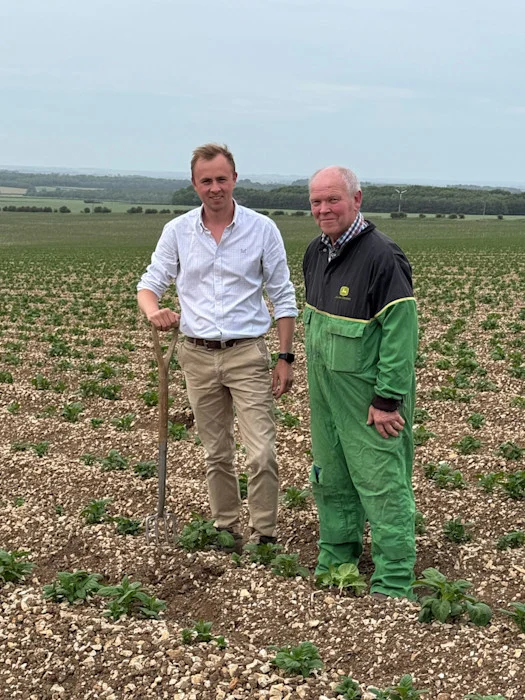
Pictured: James Taylor and father-in-law Chris Kendall
After a cool start to the season - some potato crops on the Wolds were planted into soil temperatures of 7-8degC in early April - warmer conditions and rainfall accelerated crop development and emergence was generally very consistent.
“Emergence has been relatively even, so the timing of the first late blight spray should have been timed more accurately across the board this season,” says James.
However, while fungicides remain essential, effective blight control began well before the first spray was applied, through managing volunteer potatoes and removing spoil heaps, both potential sources of blight and virus. With blight risk periods recorded in Yorkshire since early May, any emerged volunteers could act as a source of infection.
No blueprint
James builds late blight control programmes around seven-day spray intervals. A typical programme will involve 12 to 13 fungicide applications over the season, but there is no blueprint, he maintains.
“There is no set programme as such - it has to be adapted to the variety, harvest date and the blight risk,” he says. “If you have a fast-growing variety such as Marfona, you need to ensure systemic coverage starts sooner than on a variety that is slower out of the ground, to protect vulnerable new foliage.”
The first sprays are applied when emergence is nicely visible down the row, with early sprays focused on tuber blight protection and kickback activity. Protectant products such as Ranman Top® (cyazofamid), will often be partnered with C50® (cymoxanil) for kickback.
During rapid canopy expansion James looks for systemic fungicides capable of protecting rapidly developing foliage.
Resistance concerns
While products such as Zorvec Entecta® (amisulbrom + oxathiapiprolin) and Privest® (ametoctradin + potassium phosphonates) will be included, James is cautious about resistance risks - the emergence of newer blight strains, including concerns around EU43 detected in Suffolk late last autumn on groundkeepers, have reinforced the need for robust anti-resistance strategies, he says.
“We know we’ve seen breakdowns in the CAAs and Zorvec (OSPBI)-type products. With these new blight strains, we need to make sure any active under pressure is partnered with an effective mix partner, even if that means looking at older actives.”
This has led to increased use of fluazinam in tank mixtures wherever appropriate, and once the initial 'rush' of new foliage during rapid canopy has occurred and has been protected James looks to the systemic and translaminar activity of Infinito® (fluopicolide + propamocarb hydrochloride) to provide good penetration throughout the fully formed canopy.
No known resistance to Infinito’s active ingredients has been identified to date, he notes, adding that understanding local blight populations is increasingly important, as resistance to a single fungicide group can eliminate multiple products from the toolbox.
“As a product Infinito® is a perfect fit within an anti-resistance strategy where we are alternating MOAs,” says James.
“When you look at FRAC guidelines, there may be several actives within the same chemistry group, such as the CAAs. If resistance develops, that could knock out three or four actives at once.
“We’ve got a limited number of actives, and we’ve just lost mancozeb, so we have to be even more on the ball with knowing what we’re dealing with,” he says.
Bayer Technical Specialist Tom Astill confirms that the company’s own blight monitoring has identified no shifts in sensitivity in late blight to any of the active substances within Infinito®. He also underlines the importance of an early start to blight control programmes for season-long control.
“We want to start protecting the crop early and we can do this with Infinito®, which offers good systemic protection and good zoospore activity too,” he says.
Gathering data
A keen advocate of innovation and data-driven decision-making, James makes use of forecasting and diagnostic tools to strengthen local disease intelligence, combined with regular in-field monitoring.
“The go-to for me is the Hutton Criteria (BlightSpy) website for ease of use,” he says. “There are several linked weather reports within our region.”
He also uses the Dacom forecasting model in some situations, although it requires more detailed field-specific input and dedicated weather stations, he adds.
Alongside forecasting tools, he values the blight genotype information supplied for samples submitted to the Fight Against Blight monitoring service, run by The James Hutton Institute, and sees local monitoring as essential because blight populations can shift rapidly.
“One lesson from EU43 is to make the most of every opportunity we have to sample blight lesions, regardless of whether growers are certain about a positive identification, and submit them to FAB,” he says.
“When EU43 is going to hit us here on the Yorkshire Wolds, we’ve no idea. The more data we can gather to tailor our programmes, the better.”
Fight Against Blight (FAB) data collected previously within East Yorkshire reflects the wider pattern of blight genotypes found across much of the UK, with EU_36_A2 continuing to be the dominant strain within the national population, he adds.
Alternaria post-mancozeb
While late blight remains the primary concern, James is also increasingly focused on Alternaria (early blight), particularly following the loss of mancozeb. On windy and unirrigated Wolds sites, stress-related Alternaria can become a significant issue during hot and dry weather, he says.
“And if we continue to get hot, dry spells, it’s going to become even more of an issue. Attention to detail is key.”
Varietal susceptibility adds another layer of complexity, with several varieties grown in the region susceptible to Alternaria.
Already using fluopyram + prothioconazole (Caligula®) within the programme, especially on irrigated crops, James will continue to look to these actives for early blight control. Managing fungicide-resistant Alternaria populations is also becoming a growing consideration given the loss of mancozeb, he adds.
“I think this coming season we're going to see how varieties respond and where the gaps in chemistry, nutrition or fungicide programmes might be,” he says.
As blight genotypes continue to shift and chemistry options decline, knowing your enemy has never been more important, he concludes.
Infinito® contains fluopicolide+propamocarb hydrochloride. Caligula® contains fluopyram + prothioconazole. Privest® contains ametoctradin + potassium phosphonates. Ranman Top® contains cyazofamid. C50 WG® contains cymoxanil. Zorvec Entecta® contains amisulbrom + oxathiapiprolin. Infinito and Caligula are registered trademarks of Bayer. All other brand names used are trademarks of other manufacturers in which proprietary rights may exist. Use plant protection products safely. Always read the label and product information before use. Pay attention to the risk indications and follow the safety precautions on the label. For further information, including contact details, visit www.cropscience.bayer.co.uk or call 0808 1969522. © Bayer CropScience Limited 2026.
We Highly Recommend:
Fungicides
Infinito
Infinito gives you control of all stages of the blight life cycle, as well as providing long-lasting control of foliar and tuber blight in order to maximise yields in your potato crop.
Read moreFungicides
Caligula
Caligula is a systemic fungicide for use in potato and sugar beet crops.
Read more