Midlands: 4 key decisions to help you control cereal diseases this May
Ben Giles highlights 4 key decisions for cereal disease control programmes this May.

Posted 6 years ago
06/05/2020
Ben Giles highlights 4 key decisions for cereal disease control programmes this May.
Most areas of the central Midlands from Oxfordshire up into Northants have benefitted from two lots of rain in mid- and then late April totalling up to around 40mm as we head into May. Many wheat crops drilled prior to 30 October had their T1s in either the third or fourth week of April prior to the rain. For later drilled crops it is imminent as I write.
Oilseed rape is fully in flower, where it has survived, and most protected it against Sclerotinia prior to the rain at the end of April, where it made sense to do so.
Spring barley will kick on quickly now that we’ve have had a decent rain.
Late drilled wheat crops are catching up fast – even those drilled in late January have rushed through growth stages, so any that have not already been sprayed at T1, will be ready imminently.
The big challenge with these crops is knowing how much to spend on them, with virtually no trials data to support decision-making. I would suggest a Proline (prothiconazole) + chlorothalonil (CTL) at T1 could be enough, although a reduced dose Aviator (bixafen + prothioconazole) would also make a good base.
By T2 these crops will have further caught up to earlier drilled wheat, so I suspect the difference in timing might only be 5-7 days. They might well be short though, so keep monitoring carefully so you don’t get caught out and miss the timing thinking there’s no way they can be ready yet.
Spend at this timing should be somewhere close to what you would do on earlier drilled crops. The lower disease pressure generally seen in later drilled crops is being countered this season by no T0 being applied on these crops, and the T1s generally coming after the rain in April. Even assuming the T1s were applied shortly after, they will rely on some kickback and with less chance that you can apply CTL with the T2, they might be in a slightly less good scenario than earlier drilled crops.
That probably means you should be looking at something like Ascra (bixafen + fluopyram + prothioconazole) at 1.0 L/ha in these crops as the flag leaf spray.
Watch Ben Giles video for the latest progress from the Hinton Waldrist Field Day site in Oxfordshire. Around 50mm of rain has helped crops take up nitrogen and grow quickly in recent weeks. T1s were applied to these plots on 26 April. Watch the video to look at disease levels in various key varieties.
This is going to be the key question for any grower with stocks of chlorothalonil in the shed to use up. It needs to be applied by 20 May, otherwise you’re going to have to pay for it to be disposed of.
In my area, you’ve probably only got two crops to use it up on either spring barley at T1 or wheat, as hardly any winter beans have been planted.
On earlier drilled wheat crops where you’re confident of applying the T2 before that date, then mixing it with Ascra at that timing makes sense. But on crops where you’re not going to get it on before then, it could make it a season to consider a T1.5 and apply a straight CTL to protect leaf 2.
If yellow rust has reared its head again you could add some tebuconazole, and the timing might also coincide with a Terpal (ethephon + mepiquat) if any late-season growth regulator is required or missed with a herbicide for a late flush of broadleaved weeds, such as cleavers.
But whatever you do, don’t use this as an excuse to change the T2 timing, which will be a recipe for disaster. All you are doing is effectively splitting the chemical load that you would usually put on as the flag leaf spray.
The rain in April, and more is forecast for early May, will only have increased Septoria pressure, although that will only start to become clear in untreated crops around the flag leaf timing – around 21-28 days after the rain.
Assuming yellow rust has been taken care of with the earlier sprays, your T2 choice is largely a two-horse race between Ascra and mefentrifluconazole + SDHI based products. There is no doubt the latter is a very good Septoria product, but do we need something this season at that cost?
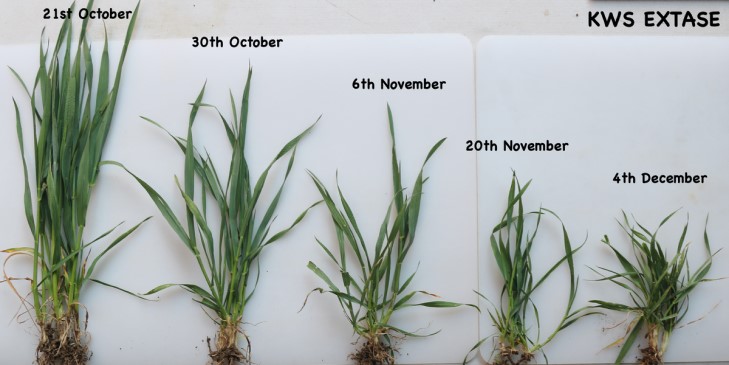
For most crops depending on variety susceptibility and drilling date, either 1.0 L/ha or 1.2 L/ha of Ascra will do a good job. On varieties such as Graham, Extase and others with a strong 6 or higher for Septoria resistance, the lower rate plus CTL (if applied before 20 May) should be fine. If you don’t have CTL, you might want to take the £6/ha you would have spent on CTL and up the rate to 1.2 L/ha.
There’s little reason to go up to 1.5 L/ha usually, unless you’ve missed the T2 timing by more than 7 days and it’s been raining, and you need the extra kickback.
There’s a lot of spring barley in the ground in this area and the rain should get it racing now. For those who have stocks, including CTL in the T1 can help with Ramularia control. The key timing is obviously T2, but that is likely to be too late to use CTL and there is data that the earlier timing can help.
Mix it with either Siltra (prothioconazole + bixafen) at 0.4 L/ha or Fandango (fluoxastrobin + prothioconazole) at 0.75 L/ha to help keep the crop free from disease and therefore less stressed as we approach the T2 timing at the end of the month.
At T1 look out for seed-borne net blotch. With seed difficult to get hold of for spring barley, some stocks have been planted with higher levels of net blotch infection, which is showing in some crops already. Higher doses of prothioconazole are the key for the disease, with partial resistance to strobilurins and SDHIs. A minimum of 0.4 L/ha of Siltra is needed, perhaps more where pressure is higher.