Aviator effective for tackling key OSR diseases at flowering
Aviator’s approval in oilseed rape last November gives growers an effective new option for tackling Sclerotinia and light leaf spot at the flowering spray timing, plus other potential crop benefits.
At the recommended 0.75 L/ha rate, Aviator delivers the same amount of prothioconazole as Proline at 0.46 L/ha, but with added benefits to disease control and crop physiology from the SDHI bixafen.
Bayer trials have seen 5% better Sclerotinia control from Aviator, while the margin over input cost in the absence of disease across 12 trials was £35.23/ha (at £387/t for OSR), illustrating the potential to enhance crop greening and yield-building capacity, says Bayer’s Jennie Watson:
“We’ve seen in cereals how Aviator delivers increased chlorophyll in the absence of disease and that’s also true in oilseed rape. It’s a more rounded option than straight Proline featuring two modes of action, which is good for resistance management.”
Aviator also benefits from Bayer’s patented Leafshield formulation system, which improves spreading, penetration and drying. Originally developed in cereals, Leafshield has notable advantages on oilseed rape’s waxy leaves. For best results, Mrs Watson recommends applying Aviator at 0.75 L/ha in 200 L/ha of water at early to mid-flowering. This gives around three weeks protection, which could be followed with another spray if flowering is protracted and/or disease pressure is high. She acknowledges the trend towards applying one flowering spray to reduce costs, so if this is the case growers should use the most effective option.
Bayer’s 2019 Judge for Yourself trials reinforced Aviator’s benefits.
Farm trials deliver yield benefit in 2019
Russell McKenzie – John Sheard Farms
At John Sheard Farms, Cambridgeshire, there were noticeably higher yields from using Aviator at flowering in 2019 Judge for Yourself trials and Russell McKenzie is keen to see whether that can be repeated.
Mr McKenzie farms 995 ha of predominantly heavy land near Huntingdon, which this season includes 200 ha of hybrid and conventional oilseed rape alongside other cropping.
His Judge for Yourself trial compared a mid-flowering application of Aviator at 0.75 L/ha against his farm standard of 0.15 kg/ha Filan and 0.6 L/ha Amistar, on a 5 ha plot within a 14.5 ha field of Ballad oilseed rape, direct drilled on 20 August.
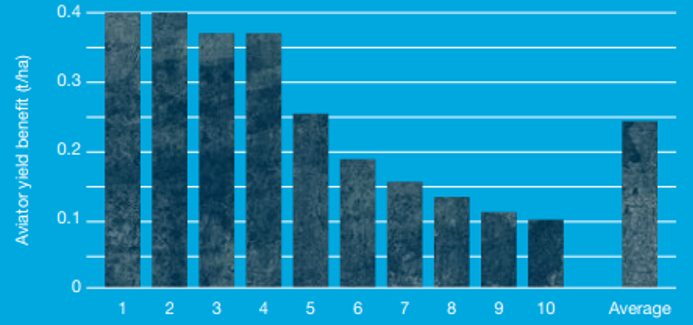
The whole field yielded well, with Aviator-treated plots taken from the fieldwork (no headlands) averaging 5.59 t/ha, which was 0.37 t/ha more than the comparison.
“There was definitely a yield boost from Aviator; it was noticeable on the combine yield meter and in the tank. We’ll have another look this spring with a larger split-field comparison, but I can see Aviator has a place as a flowering spray.”
While two flowering sprays may be ‘belt and braces’, Mr McKenzie prefers one spray given the risks to oilseed rape margins from flea beetle damage.
“Previously, we’ve had crops that looked terrific through the season, but disappointed at harvest, yielding sub-4 t/ha, which is below our 4.25-4.75 t/ha farm average, so you never quite know.
“Oilseed rape is not cheap to grow and in many seasons one well-timed flowering spray is adequate, providing there isn’t big Sclerotinia pressure. If we’re only using one spray, we want to get the best return.”
He acknowledges Sclerotinia risk is weather-dependent, so if flowering is very warm and wet, there may be a case for two sprays.
Applying Aviator at mid-flowering benefited crop greening and yield consistency in Judge for Yourself trials at Hoe Hill Farm near Market Rasen, Lincolnshire, according to Alex Borthwick, who farms 880 ha of combinable cropping, potatoes and sugar beet for R M Cottingham.
Last season’s 5 ha trial area of hybrid Incentive was split between two fields with slightly different soil types to see how a mid-flowering application of Aviator (0.75 L/ha) compared against the farm standard of 0.6 L/ha Amistar and 0.35 L/ha Proline.
Combine yield mapping shows Aviator delivered 0.12 t/ha more than the comparison treatment in one field and a slightly smaller increase in the other. Mr Borthwick, who is BASIS-qualified and does all the farm’s agronomy, was happy with Aviator’s performance in a challenging season that featured dry growing conditions and heavy rain at harvest, which caused yield losses of up to 0.2 t/ha in some fields.
“Our farm average for oilseed rape was 3.1 t/ha last year, whereas we’d normally be around 4 t/ha. It was so dry that stressed crops never really got going, especially on lighter Wold land.”
Despite the conditions, he believes areas treated with Aviator remained green slightly longer and yield maps indicate this resulted in better yield consistency. The farm is hosting Judge for Yourself trials again this season, and Mr Borthwick plans to use Aviator on a slightly larger proportion of the oilseed rape area, which includes Aurelia, DK Exstar and InV1035.
While 30 ha was lost to flea beetle damage last autumn, the remaining 110 ha received an autumn spray of Proline for Phoma and light leaf spot. This is usually followed by two flowering sprays; one based on Proline and Amistar at early flowering, then Amistar at late flowering.
“I’ve always thought the later strob gives more consistent and higher yields, but our trials suggest Aviator at mid-flowering brings something extra to the flowering spray, so we will have another look this year.
“The 2019 trial was on lighter land, so we may have seen more benefit on heavier land, therefore we’ll try different locations this spring.”
We would like to use optional cookies to better understand your use of this website in order to improve our website. Your consent also covers the transfer of your Personal Data in unsafe third countries, especially the U.S., involving the risk that public authorities may access your Personal Data for surveillance and other purposes without effective remedies. Detailed information about the use of strictly necessary cookies, which are essential to browse this website, and optional cookies, which you can reject or accept below, and how you can manage or withdraw your consent at any time can be found in our Privacy Statement