10 things to consider before you cut fungicides in wheat in 2019
If there’s one person who knows a thing or two about winter wheat disease management it is NIAB TAG director Bill Clark. We asked him what to consider before considering if you can reduce fungicide rates this season. Here are his 10 factors to consider.
They are only a guide. The response of varieties rarely correlates to their Recommended List rating, particularly in high pressure Septoria and yellow rust situations. So it is worth combining national Recommended List data with regional, and if possible local, data to look for some consistency in results before deciding whether a variety will respond as per the Recommended List.
Even resilient varieties (low risk varieties) show regional variability to fungicide responses.
2. Sowing Date
There is no way of accurately calculating the impact of drilling date on variety disease rating, but remember Recommended List data is generally drawn from plots drilled around mid-October. For any crop it’s important to be vigilant, but for wheat drilled in September or early October it is likely to be exposed to greater pressure so keep a close eye on these in particular.
3. Compromised Spray Timing
Even the best SDHI fungicide is no ‘silver bullet’ against Septoria. Once the latent period is half-way through, even an eradicant fungicide is not going to fully control the disease. As mycelia is spreading inside the leaf, the next generation of infectious spores are already being formed in pycnidia (fruiting bodies), and no fungicide will be effective.
Symptoms may not be visible, but the damage is done. So if your spray timing has been compromised then it is becomes harder to reduce rates.
4. Spray Capacity
Can you cover your wheat area at the correct timing? The target leaf needs full protection and even the most systemic fungicides won’t protect new growth, so disease is almost certain to establish. The weather might save you – but you are in the lap of the gods.
5. Will You Miss Out On Value Added Fungicides
Yield responses to fungicide inputs are not all about disease control – many modern fungicides have direct or indirect effects on the crop, Plant Growth Regulator effects, greening effects, rooting effects – many of which contribute to yield response to fungicide treatment.
6. How Much Will You Save
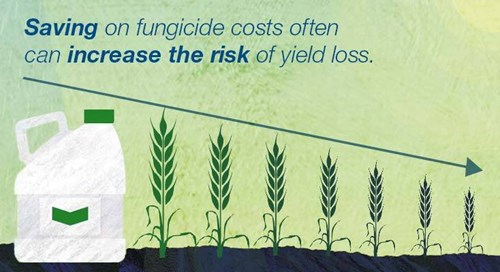
Saving on fungicide costs often just increases the risk of yield loss. Cutting rates might save you £5-10/ha – but you’ll lose more to Septoria if it gets established.
If you gamble on a low disease year and it doesn’t turn out that way, NIAB TAG data shows you will lose three times the amount you ‘lose’ by spending too much in a low disease year. It is more cost-effective to spend a little too much in a low disease year than it is to spend too little in a high disease year.
7. The Weather
The speed ofSeptoriadevelopment can be rapid in wet and humid conditions, and low pressure situations can become high quickly.
Also check crop winter development – can Septoria be spread by leaf contact? In recent seasons we have seen thick, lush crops in early spring due to mild conditions, which of course will favour the disease anyway.
8. Nutrition Strategy
Are you fuelling disease? YEN has shown the value in higher ears/m² and the role of early biomass in achieving this. Pulling some of your N forward to increase biomass will encourage growth and canopy development, but also disease development.
9. Product Stewardship
Azole and SDHI fungicides need to support each other. Are you running the risk of one being exposed through a reduced rate of a partner?
Azole performance has declined over the last 10 years but they are still useful protectants. If the azole rate is too low it will expose the SDHI partner, hastening the onset of resistance.
10. Optimum Fungicide Tool
Developing an appropriate fungicide strategy based on disease pressure, variety, drilling date and regional factors is complex - so to help growers in this area NIAB TAG has developed a members only tool to indicate optimum programme margin over input costs.
We would like to use optional cookies to better understand your use of this website in order to improve our website. Your consent also covers the transfer of your Personal Data in unsafe third countries, especially the U.S., involving the risk that public authorities may access your Personal Data for surveillance and other purposes without effective remedies. Detailed information about the use of strictly necessary cookies, which are essential to browse this website, and optional cookies, which you can reject or accept below, and how you can manage or withdraw your consent at any time can be found in our Privacy Statement