Check nozzle choice for spring herbicide application

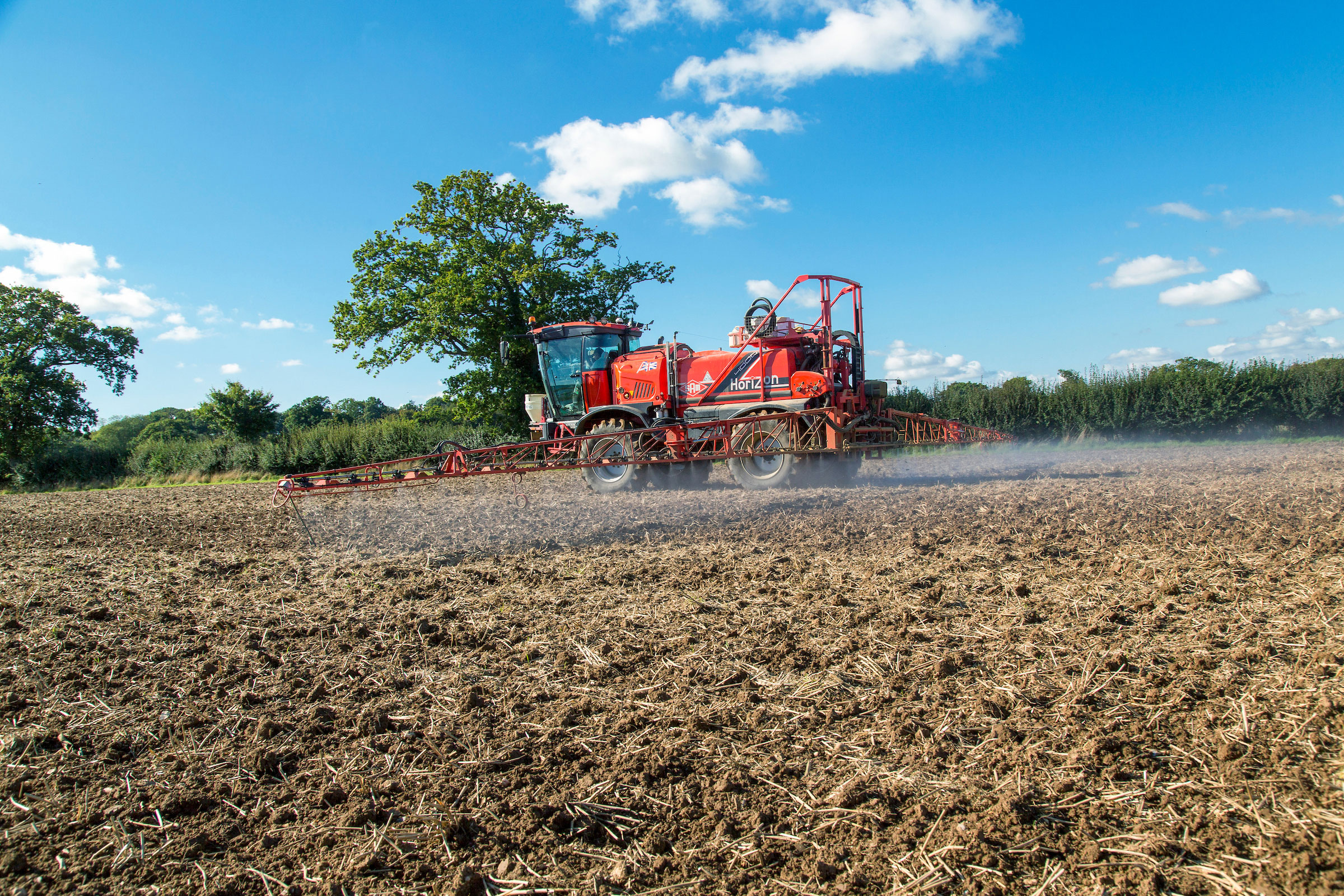
Nozzle choice has a huge impact on herbicide performance in spring, whether it is post-em sprays in winter wheat or tidying up stubbles before spring sowing.
In partnership with Independent Application Specialist Tom Robinson, Bayer commissioned trials to assess how nozzle choice and boom height affect drift and efficacy of Roundup (glyphosate) in spring
“We wanted to have better information on Roundup application to help farmers improve stewardship and performance,” says Bayer’s Roger Bradbury. Although the focus was glyphosate in stubbles, the results are also relevant for other contact acting herbicides such as Atlantis Star (mesosulfuron + iodosulfuron + thiencarbazone), here are main findings.
Four nozzles at two boom heights (0.5m and 1m) were used in the trials to apply 100l/ha Roundup to a field of spring wheat, which was used to simulate a stubble. The 110 fanjet, the standard label recommended nozzle, performed worst. It caused more drift without improving weed control.
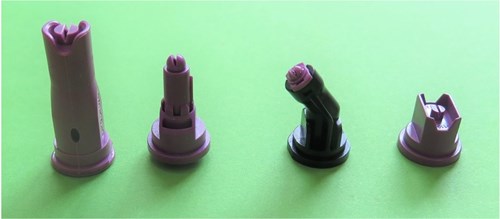
(Nozzles from left to right, Lechler ID3, Hypro Guardian Air, Hypro 3D, 110 Fan Jet)
“The other three nozzles performed roughly in line with expectations,” says Mr Robinson. “The 3D gave the best control but is prone to drift. The Lechler ID3 was the least drifty but this resulted in slightly lower weed control. The Hypro Guardian is a good compromise option.”
“In ideal conditions, up to force 2 winds with few stronger gusts, the 3D is the best option, at higher windspeeds The Hypro Guardian or the Lechler are probably a better choice to prevent drift.”
“Drift is bad for compliance and for the image of the farmer, but it also shows that application is less than ideal. If you are spraying with lots of drift you will get a worse result,” says Tom Robinson. He points out that contact acting herbicides need to land and settle on the target leaf, so the correct spray quality is vital. If it is too fine, it drifts away but coarse sprays will land on the soil instead.
“Angling nozzles helps when hitting small upright targets such as grass-weeds because more of the target is hit directly by the spray. For the 3D, the angle is set to 38 degrees, but other nozzles can be angled in a similar way to improve coverage,” says Mr Robinson.
Boom height is the single biggest factor in levels of drift, setting the boom to 0.5m above the crop is the most important step to take regardless of nozzle choice. Setup and maintenance are important here because the boom must be stable to apply this low down. If it is unstable, the easiest fix for the operator is to increase the height causing more drift and poorer spray coverage.
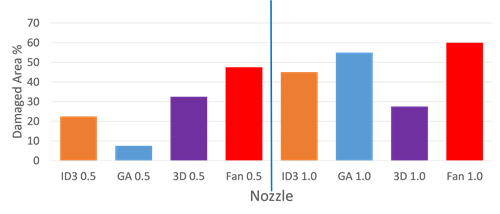
Area of damage 5m outside of swath at nozzle height 0.5m and 1m.
Damage from drift increases with height, the ID3 was the least drifty nozzle. The surprise result for the 3D nozzle at 1metre is probably because a temporary drop in wind speed during application.
The trial took place at 12km/h in good spraying conditions against an easy target, on farm things can be more difficult, points out Mr Bradbury. “The differences between nozzles and height were small but we have to consider the implications on farm. Any differences would be magnified at higher speeds, in more difficult conditions and aiming for a more challenging target – all of which might be true when farmers go out to spray this spring.”
He emphasises that forward speeds should be at a maximum of 12km/hr, any faster risks poorer coverage and control. Targets in spring can also be challenging, over-wintered broad-leaf weeds and perennials both need high rates of glyphosate (1440 – 1800g) to get control.
Mr Robinson agrees and points out that in his experience fungicides can go on at 16km/hr without any loss of efficacy, but 12km/hr is the top speed for herbicides, less over uneven ground.
With cold snaps persisting into March, patience is key because glyphosate or Atlantis applications in cold weather do not perform as well. After a cold spell, wait for active growth to be back in full swing to give the herbicide the best chance of success.