Data Library To Drive Sustainable Success

Helping farmers plan their future farm strategies in an evolving farming landscape is where FieldView can really add value.
Simon makes the point that the landscape at Dunsden Green could look very different in the future. “The view out of the farm office could be quite different a few years from now. Some fields will remain exclusively for cropping but others could be partially cropped with other parts of the field put aside for environmental schemes. Equally, in some seasons, an entire field might be exclusively down to an environmental scheme.”
However, Simon is delving deeper and says the cropping landscape could be different too. Wheat is likely to remain the driver for farm profitability but Simon isn’t ruling anything in or out at the moment. “There’s still plenty of questions. Do I drop out underperforming break crops, or only grow spring crops in certain fields where I have the evidence they will perform.
“With wheat, if the entire field isn’t going to produce a profit do I take out the unprofitable areas completely, or scale down input investment? In the past we’ve been trying to even up entire fields. Where we are moving to is getting the better field areas to produce even more. With the more marginal land it is recognising which areas can still achieve a margin by scaling inputs. There is a lot to resolve, which is why I need data.”
There’s the added complication of highly variable soils, and of course variable weather. The farm has 16 different soil types from clay caps to gravel to chalk seams. It presents a compromise straight away as trying to set the drill to achieve consistent cereal seed depth at 35mm just isn’t possible he acknowledges.
Weather impacts compound soil issues. “Last season it was dry at harvest and we had grain going off the farm at 10%, the season before we had to dry everything. For autumn 2019 we could hardly get crops in the ground. Do we gear up for wet seasons, dry ones or a happy medium? It’s another challenge I have to find an answer to.”
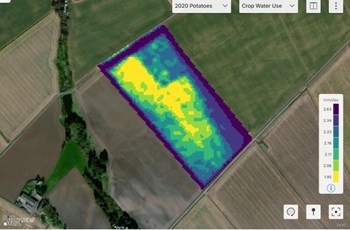
But the library will also help him better understand climate impact too. “Weather variability means whilst one area of a field benefits another suffers, which varies by the season. Building up layers of seasonal data will help me better understand the impact of climate across all field areas and crops – whether that is good or bad. Having the fullest possible picture of how the various parts of each field behave can only help me plan better for the future.”
It might appear obsessive to some, but the adage better informed is worth considering. In an industry exposed to so much volatility, good data is important. What works best, when and where will come from the data Simon is compiling with FieldView and other platforms. Simon is all too aware that if the enterprise is to deliver environmental gains it also has to remain profitable.
A good example of what works best and where is a possible change in wheat strategy. To date, the business has focused on milling markets but he isn’t averse to change. This comes following a variable rate N trial with wheat following forage maize.
The aim was to see whether the 40 t/ha of farmyard manure applied to the maize would allow for a N reduction in the following wheat crop. Rather than his usual 260 kg/N/ha he established a number of field strips of 150 and 180 kg/N/ha to see the impact.
Interestingly, the strips yielded the same but trialling of an onboard protein monitor with John Deere picked up differences between the two treatments, confirmed by further analysis. “There was no real difference in yield for both treatments but in the 150 kg/N/ha strips the protein came in at 11.5%, the 150 kg/N/ha strips at 12.5%. This is food for thought. In the future do we move from milling to feed wheats where we can reduce the amount of fertiliser.”
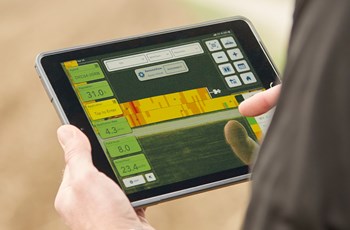
That’s what Simon particularly likes about FieldView, the ability to divide fields into blocks, apply different treatments and gather accurate data for evaluation.
He is using data from platforms such as Soyl and FieldView to evaluate a range of agronomic refinements. These have highlighted biomass variations, allowing in season fine-tuning. He has used these to tailor N rates to hit milling wheat spec and apply PGR variably.
The latter has shown to be particularly beneficial. He was sure PGR rates were excessive in the poorer field areas. Variable rates have seen wheat field averages rise by 0.25 – 0.5 t/ha dependent on the season. “This increase was down to an improvement in crop performance in the poorer field areas. Crops in these areas couldn’t cope with the higher rates.”
With variable N and PGRs Simon has also undertaken variable rate fungicides trials and now he is looking at field mapping for weed control strategies, adding to what will be a comprehensive library to call upon.