Velum Prime promotes sustainable nematode control

Posted 4 years ago
30/03/2022

Plant parasitic nematodes are the “unseen enemies” of plants because the disease symptoms they cause are non-specific and often go unnoticed.
Managing nematode populations has become increasingly difficult with growers having to develop integrated policies that combine cultural tactics with proven nematicides.
Many trials have sought to establish the contribution that catch/trap crops such as Sticky nightshade (Solanum sisymbriifolium) and biofumigants, notably Indian mustard (Brassica uncea), can make to population management.
The results are highly variable and often dependant on environmental conditions during the growing season. The high economic cost of these measures and the unreliability of success is therefore seen as a barrier to wider adoption.
In carrots, the threat posed by plant parasitic nematodes is especially acute. Infestations can cause stunting or fanging of roots, reduce water and nutrient uptake efficiency and decrease crop growth. Despite the high economic loss caused by nematodes, no nematode-resistant varieties are commercially available, and the pesticidal options are limited.
Identifying which species of cover, trap or biofumigant crop will best perform in any given situation will depend on the species to be controlled.
The root-lesion nematode (Pratylenchus pentrans), for example, has a wide host range which includes oats, radish and oilseed rape. Other species, such as the root-knot nematode (Meloidogyne spp.), are better controlled by oil radish but any benefits that come from its use may not be seen in the same growing season.
Research performed in Michigan, USA, found that it took nearly a year for the nematode balance to change following a cover crop of oil radish.
In the absence of resistant varieties and reliably effective catch or biofumigant crops, growers remain reliant on nematicides.
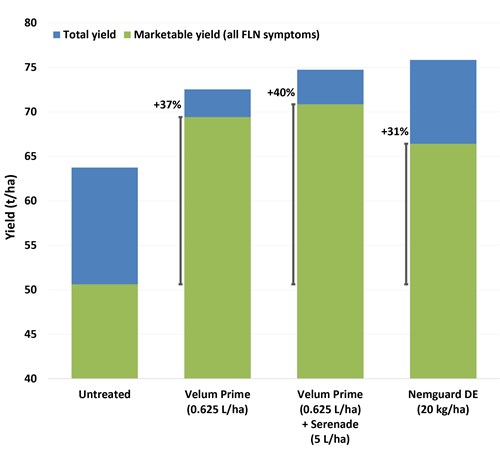
Chart 1 shows the results of trials performed at Hockwold, Norfolk on a crop of Nairobi carrots in 2021. The trial found that Velum Prime (fluopyram) applied by broadcast spray and incorporated to a depth of 10-20 cm prior to drilling increased marketable yields by almost 40% compared with the untreated and nearly 10% over Nemguard DE (garlic extract).
Chart 1: Velum Prime increases marketable yields versus the untreated and beyond that achieved by Nemguard DE
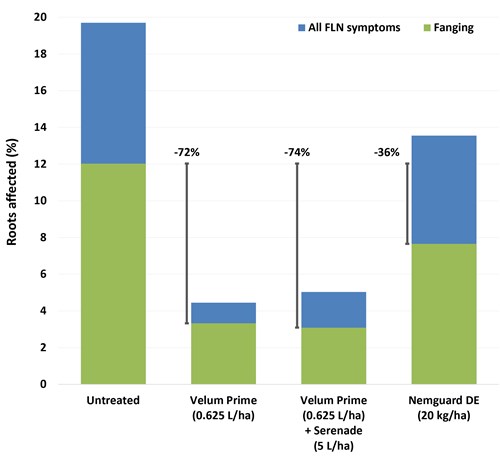
Perhaps, more telling is the reduction in symptoms caused by free-living nematodes from the use of Velum Prime both alone and in a co-application with Serenade ASO (Bacillus amyloliquefaciens strain QST) 713) compared with that achieved by Nemguard DE.
Chart 2 shows how the use of Velum Prime, with or without the addition of Serenade ASO, resulted in a reduction in fanging almost double that achieved by Nemguard DE.
The results, which build on the performance seen in previous studies, provide compelling evidence of the yield protection afforded by Velum Prime in moderate to high-pressure situations.
Pre-sowing soil testing found the site as heavily infested with Stubby root nematodes (Trichodorous spp.), Stunt nematodes (Tylenchorynchus spp.), spiral nematodes, (Helicotylenchus spp.), root-lesion nematodes and needle nematodes (Longidorus spp.).
Chart 2: Percentage of roots affected by FLN symptoms. Velum Prime reduced the quantity of roots affected by fanging by 72% compared with untreated – double that achieved by Nemguard DE