Prepare for the blight ‘double-whammy’: 5 steps to combining late blight and Alternaria protection in a difficult season

Posted 5 years ago
16/07/2021
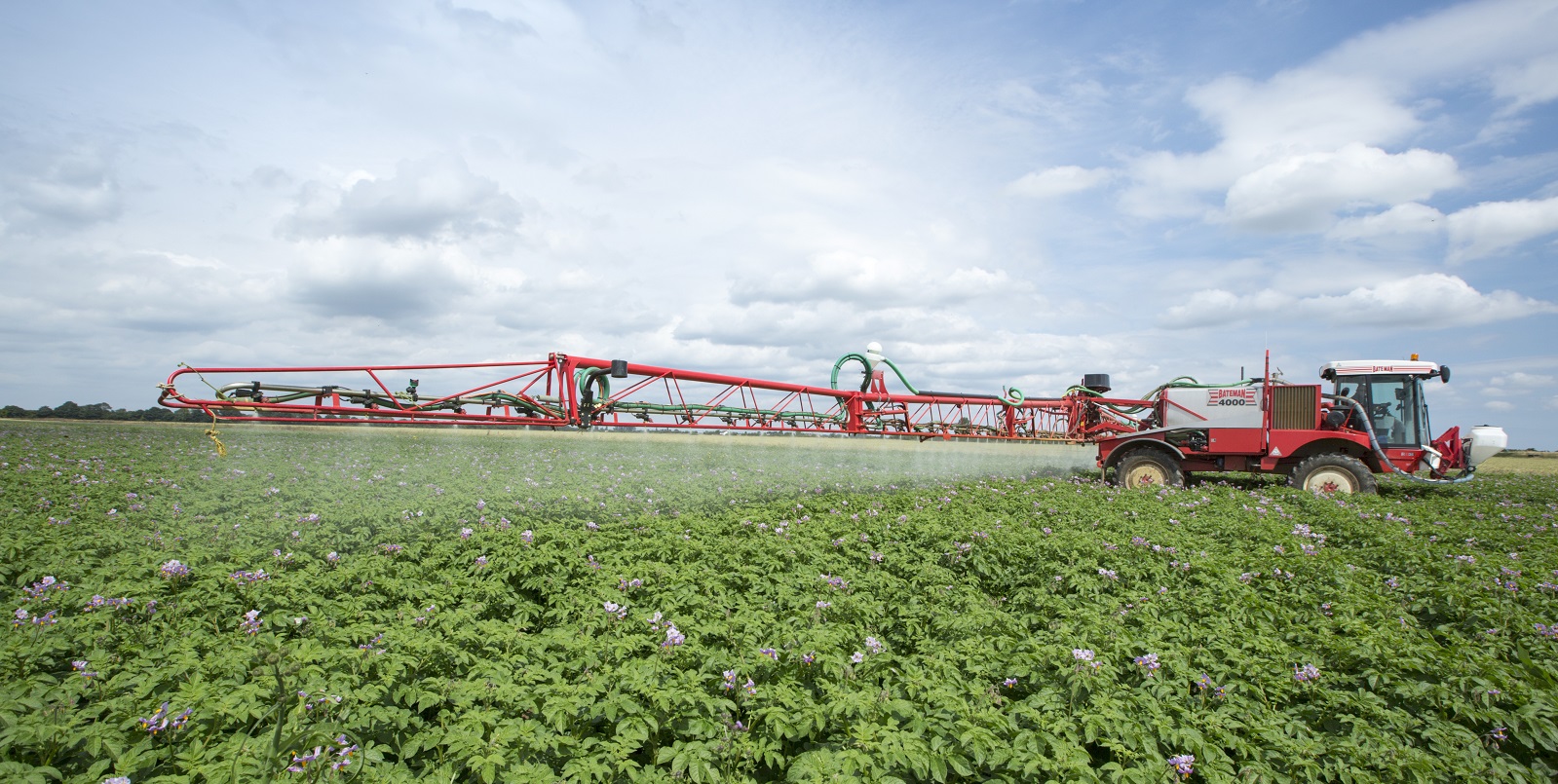
As a period of mild and humid weather is set to affect large swathes of England, Scotland and Wales, potato growers are being advised to monitor crops for outbreaks of late blight (Phytopthora infestans). Where growers have been unable to secure supplies of mancozeb, there is a risk that early blight (Alternaria solani and A. alternata) will infect susceptible maincrop varieties too.
“Crops have faced little in the way of late blight pressure so far in 2021, but conditions were always likely to change at some point,” says Eric Anderson, senior agronomist at Scottish Agronomy.
“The challenge confronting growers is how best to manage the twin threat of early blight and late blight in crops at vastly different stages because of the protracted start to the season. Achieving this in practice is likely to be a logistical challenge,” he adds.
While late blight is well understood, and to a large extent one with which growers will be familiar, Mr Anderson regards early blight as an equal threat.
While the two diseases may share similar sounding names, they are vastly different.
“The name early blight was proposed to differentiate this disease complex from late blight. Early blight was prevalent in early maturing cultivars and less so in medium or late maturing ones, whereas late blight was more serious in medium and late maturing cultivars,” he explains.
The control of early blight will be a considerable challenge in the future with its increasing importance due to a range of factors. A changing climate with more extremes of weather during the summer months is creating conditions more conducive to infection, disease spread and rapid development.
Higher temperatures during the growing season result in favourable conditions for the pathogen. More abiotic stress (drought) increases the susceptibility of the plant and will therefore also promote disease progress.
In addition, historically there has been a lack of product stewardship against early blight with programmes typically based on sequential treatments of products containing only a single mode of action. The consequence of this has been the development of strains exhibiting reduced sensitivity and in some cases resistance to certain modes of action all of which means growers will find it more costly and complex to control.
“There is a better than fair chance that early blight will catch growers out this season. The loss of mancozeb and the incidental control of early blight it provided serves to emphasise the difficulty confronting growers,” says Mr Anderson.
“To offset this cost increase, growers will have to adopt more cultural practices, such as effective trash management across the rotation and proper control of volunteers and ground keepers. It will also require the wider adoption and market acceptance of cultivars less susceptible to the disease and greater recognition of the need to practice active resistance management throughout the fungicide programme,” says Mr Anderson.
Foliar symptoms of early blight are dark brown to black necrosis. The first signs of disease become visible on the lowest and therefore oldest leaves just a few weeks after emergence. Initially, dark brown dot-like blotches appear, a few millimetres in diameter. The necrotic area gradually increases, and the leaf symptoms grow to take up the whole of the green leaf tissue. Often, the lesions are restricted by leaf veins and take on an angular shape. The size of the necrosis can vary in width, from a few millimetres to 2 cm. Within larger lesions, a series of dark concentric rings are visible.
The principal problem is that merely based on the presence of lesions with concentric rings any leaf spot disease is considered to be Alternaria. However, concentric rings are a consequence of the influence of environmental conditions on growth and development of any type of lesion. It is virtually impossible to identify which species is present without the use of a laboratory microscope to closely study the spores. Furthermore, physiological (non-fungal) leaf spots are commonly due to ozone damage, or deficiency from manganese or magnesium.
Although A. solani and A. alternata are closely related and have many similar characteristics, their dispersal behaviour differs significantly. A. solani is a specific pathogen of potato (and outdoor tomato elsewhere in the world), whereas A. alternata has a wide host range including legumes, brassicas, carrots, beets, and several wild plant species. Spores of A. solani are produced on potato foliage and plant debris across a wide temperature range of 5-30°C (the optimum is 20°C).
The dissemination of inoculum follows a diurnal pattern in which the number of airborne spores increases as leaves that are wet with dew dry off, relative humidity decreases and wind speeds increase. The number of airborne spores generally peaks in mid-morning and declines in late afternoon and at night. External sources of inoculum play a larger role in spore introduction for A. alternata than for A. solani. A. alternata can be considered a ubiquitous fungus readily found on decaying leaves.
In contrast, A. solani overwinters primarily on infected crop debris and in the soil. Initial inoculum of A. solani is moved locally within and between potato fields. Compared to P. infestans, the initial dispersal range of A. solani is limited to the proximity of the overwintered inoculum with a reduction in spore density occurring within 400-600m, while dispersal distances can typically be measured in kilometres for P. infestans. During the growing season early blight epidemics develop via secondary spread of conidia (asexual spores). The pathogens have many asexual cycles per season where conidia are produced on infected leaves and spread by wind.
The difficulties of the season are also likely to increase plant stress which further raises the threat of early blight. During the early months of the growing season the disease develops first on fully expanded leaves near the soil surface and progresses slowly on newly emerged leaves in the upper canopy. The rate of disease spread increases after flowering and can be quite rapid later in the season during the bulking period or when the plant is under stress. Early blight is largely a disease of older plant tissues. Where positive infections are identified to species the saprophytic A. alternata, typically visually expresses first before the end of July and the more pathogenic A. solani comes in relatively later.
“Crops under stress of any form, be it caused by nutrient deficiency, nematode infestations, or other diseases such as Verticillium wilt, are more likely to succumb to A. alternata, the secondary form of the disease known to enter the crop via earlier damage. Verticillium dahliae or “early dying syndrome” is likely to be of increasing prevalence for other reasons, so growers should not overlook its potential to hit performance too,” says Mr Anderson.
How growers respond will largely be determined by attitude to risk. “The question growers need to ask themselves is, ‘how lucky do I feel?’,” says Mr Anderson.
Depending on the answer, he says, growers can choose from one of two approaches, but in an attempt to slow the spread of resistant strains, products containing a single mode of action should either be mixed with a suitable partner or alternated with a different mode of action effective against the target pathogen to promote control.
“We need to heed the lessons of the recent past and practice good product stewardship for Alternaria in the same way we have learned to do with late blight. It may be that Caligula (fluopyram + prothioconazole) sets the new standard for early blight control after mancozeb, but use will have to be balanced with that of cheaper dual-purpose options such as Amphore Plus/Carial Star (difenoconazole + mandipropamid) but with the acknowledgement that only difenoconazole provides activity against the target disease.
“You either pay a little more for Caligula with its built-in resistance management and be confident that crops will be protected or opt for a less expensive programme based around Signum (boscalid + pyraclostrobin) or Revus (mandipropamid) + Narita (difenconazole) or Amphore Plus/Carial Star and accept that the active ingredients are less well stewarded for effective future use.
“I would caution against the use of straight azoxystrobin for the control of early blight as resistance is widespread and there is mounting evidence from Europe that strains of A. solani resistant to boscalid are spreading rapidly. Decisions are best taken after due consideration of the risk and the value of the crop to be protected,” he says.
How growers and their advisers approach early blight has the potential to impact strategies for the control of late blight, especially where there is a large proportion of fungicides belonging to the Carboxylic Acid Amides (CAA) mode of action group, such as mandipropamid, benthiavalicarb and dimethomorph, in the programme.
“Growers could well find themselves with crops at vastly different stages; overcoming this may involve adopting a field-by-field approach. This will create its own difficulties. A more considered integrated programme where good cultural practices (to reduce soil borne inoculum) are practiced alongside the use of less susceptible cultivars and a balanced fungicide strategy is the only viable option for the long-term,” he acknowledges.
It has been suggested previously that balancing effective protection and resistance management principles without mancozeb will increase crop protection costs by upwards of 20% (compared with 2020).
To mitigate this, Mr Anderson urges growers to consider how they might best structure a programme to maintain protection without incurring further costs.
“The focus will soon turn to tuber blight protection, but with haulm destruction now taking longer it is prudent to budget for an additional blight spray with good anti-sporulant activity but be mindful of the costs.
“An application of Ranman Top (cyazofamid) + Enervin SC (ametoctradin) would cost upwards of £30/ha in which case it would be cheaper to apply Infinito (fluopicolide + propamocarb). As a result, my suggested three sprays at the end of the season are likely to be Infinito followed by Ranman Top + Enervin SC followed by Infinito. This limits the cost to the grower while conferring the desired protection against tuber blight,” he says.