Key Early Drilling Challenges Identified

Posted 5 years ago
27/05/2021

While early drilling can markedly reduce the impact of adult Cabbage Stem Flea Beetle grazing, moving drilling forward from its main mid-late August window brings with it a number of challenges that need to be addressed to make the most of this change.
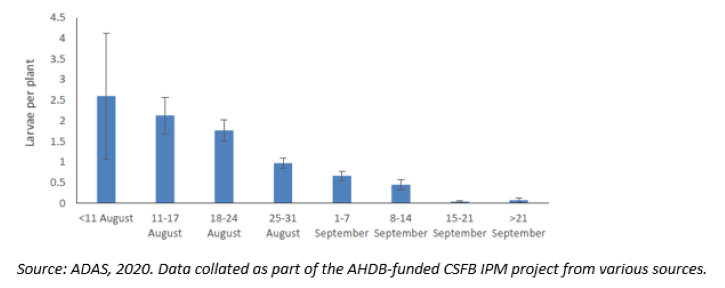
Analysis of 15 years of data from more than 1600 sites undertaken by ADAS in a three-year AHDB-funded integrated pest management project in collaboration with Bayer and other industry partners also shows it to be associated with higher levels of CSFB larvae (Figure).
Figure: CSFB Larval Levels and Sowing Date
|
|
“This is potentially because of the amount of plant growth available to support adult feeding and egg-laying over an extended period,” explains ADAS plant physiologist, Dr Sarah Kendall. “So, although much of the focus of CSFB management has been on early crop survival, everyone needs to appreciate that minimising the damage from larvae is at least as important.”
Earlier drilling will also favour pests like cabbage root fly and turnip saw fly known to cause serious young brassica losses and be as difficult to control as CSFB.
As well as supporting better crop growth, longer periods of higher temperatures ahead of winter definitely add to the threat from both light leaf spot and clubroot, and could also increase the pressure from verticillium and turnip yellows virus (TuYV).
Excessive pre-winter growth can further present serious canopy management challenges, pre-mature stem extension and particular susceptibility to damage from frost and snow, not to mention a significantly higher lodging risk.
In addition, of course, sowing in early August means very little time after harvesting the previous crop for managing straw, controlling grass weeds and correcting any soil structural problems.
“We have to get the crop established, but it also needs to be profitable,” Dr Kendall stresses. So, we must avoid falling into the trap of being content to get through the autumn and harvest anything half decent at all.
“We can’t afford to throw key elements of proven best management practice out of the window in dealing with flea beetle either. Otherwise, we’ll end up with difficult-to-manage crops that will always struggle to deliver the yields that make them worth growing.
“Instead, we have to integrate the most useful CSFB cultural controls carefully into the most productive management regimes. If this means changing when or how we establish or manage the crop we must adjust other elements of our agronomy to fit.”