Residuals still the basis of control in potato weed control programmes

Posted 5 years ago
08/03/2021

Herbicides with a strong residual performance are the best means of achieving weed control in potato crops, but which partners to use for lasting success is a question many growers and their agronomists still face.
The central issue is one of weeds to be controlled. Understanding the weed spectrum in any given field is essential to good control, but a reliance on rented land means that the knowledge needed to devise a programme is often less than complete. This can lead to higher costs in the long-term as more applications are needed to clean up weeds missed by earlier passes.
Varietal tolerance to metribuzin is also a primary consideration. Metribuzin has the widest weed spectrum of any herbicide authorised for use in potatoes, but its use is either not supported with many varieties or limited depending on soil texture.
The difficulty in finding a way forward was compounded further with the loss of diquat ahead of the 2020 season. The effect of this was to force a change in pre-emergence programmes because the alternative contact herbicides, carfentrazone-ethyl and pyraflufen-ethyl, are less effective against established broad-leaved weeds and annual meadow-grass.
Overcoming this dilemma involved changes to application timing with sprays needing to be applied roughly seven to 10 days after planting; typically once ridges are settled. Later applications risk checking crop growth.
A consequence of this change was to increase reliance on the residual component of the programme, but confusion reigns over which mixing partner to include for the best all-round control.
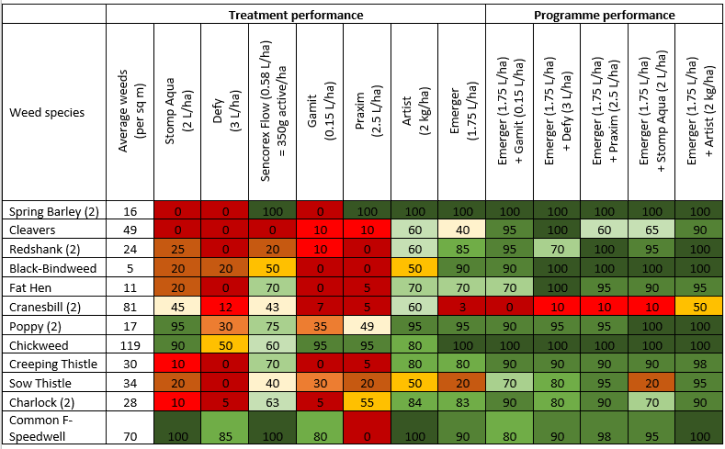
In the majority of situations, Emerger (aclonifen) will give control of the greatest number of weed species, as highlighted by the table below.
On soils where varieties will tolerate metribuzin then it makes sense to go with this as the basis of the programme and it should be incorporated in to the top 10-15 cm of soils at the final stage of cultivation ahead of planting. Where small nettle, fat-hen, orache, polygonum species and black-bindweed are a problem, a pre-emergence application of Emerger will bolster control.
Where the soil texture or variety mean metribuzin is either not a suitable option or has to be applied in low quantities, Emerger alone or in combination with prosulfocarb has been shown to deliver control. On soils high in organic matter, where residual control can be compromised by the poor ridge stability, growers have reported a level of control beyond their expectations.
Soil moisture status is another consideration. Emerger is a diphenyl-ether, which is taken up by the hypocotyls, cotyledons and coleoptiles of weeds as they push through the soil surface. It is then translocated to the meristems causing bleaching and chlorosis of the young tissue as it develops. As such, Emerger is less affected by dry soils than prosulfocarb. This brings application flexibility and offers a potential cost saving as Emerger can be applied earlier than is often needed with prosulfocarb and does not require a standalone pass to ensure optimum timing. The addition of prosulfocarb should be considered where cleavers present a challenge.
|
|
Source: NIAB TAG weed screen, Hinxton, Cambs, 2020. NB. Trial conducted in dry conditions.