East Anglia: 4 must-do jobs for arable growers this April and early May
Ella Crawford takes a look at 4 agronomic tasks for growers to focus on in the next few weeks.

Posted 6 years ago
16/04/2020
Ella Crawford takes a look at 4 agronomic tasks for growers to focus on in the next few weeks.
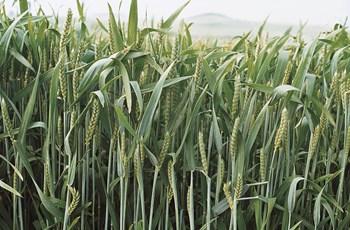
Autumn drilled wheat crops are reaching GS30 and have either had T0s or due to have them the week after Easter. Later drilled crops are a bit more behind and growth stages depend on when they were drilled.
Winter barley crops are reaching T1 timing currently and should be sprayed imminently if they haven’t been already at the time of writing, while spring barley drilling has continued apace with land drying out at the end of March and into early April. Dare I say, we could now do with some rain to encourage these spring crops to progress.
The same applies to sugar beet, while oilseed rape development is a real mixed bag ranging from stem extension through to mid-flowering.
There’s active Septoria in most wheat crops on the lower leaves. While as I write we’ve had a dry spell, the previous mild wet weather, and the subsequent warm spell was conducive to Septoria development and it will spread up the plant with rain splash events – so it should definitely not be forgotten about.
Yellow rust is also present, but hopefully higher risk crops and where it is already showing will have been sprayed at T0 with a rust-active azole or strobilurin fungicide to stamp it out, so ideally you’re going into T1 with no yellow rust present. That would allow the main T1 driver to be Septoria.
The accuracy of T1 fungicide timing will be the key to successful protection, and that won’t be easy with the extensive range of drilling dates on farm. It means dissecting plants carefully to assess when leaf 3 is emerging – ideally you want to spray when it is three-quarters emerged on the main tillers. Timing T1s based on nodal development won’t be as accurate, especially in later drilled crops so you risk spraying the wrong leaf layer.
Products like Aviator (bixafen + prothioconazole) and Ascra (bixafen + fluopyram + prothioconazole) contain robust doses of azole and will protect against the full range of diseases at T1. Including the SDHI will provide kickback activity, especially where no T0 has been applied, and strengthen protection over prothioconazole alone to get crops through 3-4 weeks until T2.
Oilseed rape is a bit of a sore subject for many growers. A lot of crops have been decimated by flea beetle larvae and pigeons in early spring, which is disappointing as there were crops that looked decent coming out of winter.
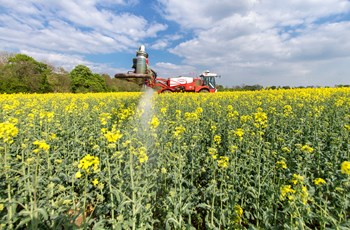
Now growers have to decide on yield potential and assess risk from Sclerotinia. Forecasting systems can help with the latter. Any crops with decent yield potential will justify one spray for Sclerotinia – remember it has to be sprayed protectantly to be effective so unfortunately it is not possible to wait for the disease to appear before deciding. The optimum timing for a single spray is just before mid-flowering.
Newly approved for the oilseed rape crop, Aviator will be a good option as it will also help top up light leaf spot control, which has been widespread this year. In farm-scale trials last year, Aviator outperformed competitor products by around 0.2t/ha on average.
Winter barley crops were sprayed around Easter for T1s, with moderate levels of disease being reported. Rhynchosporium, net blotch, brown rust and mildew are all featuring at varying levels across the county.
That means keeping spray intervals to no longer than 3-4 weeks will help keep disease under control. In winter barley, target your T2 spray around awns to ear emerging, depending on disease risk.
Siltra (bixafen + prothioconazole) with its high loading of prothioconazole and inclusion of the SDHI bixafen gives a good balance of actives in one can. At T2 you can get away with slightly lower doses than at T1 in winter barley, and assuming it is being sprayed before 20 May, then including chlorothalonil in the mix will be key for Ramularia control.
The same considerations are also true for spring barley disease control. Again, lower doses are applicable here. Some crops will be due first fungicides imminently as they are already reaching early tillering, while other crops are yet to emerge.
Earlier sugar beet drillings are already emerging so the focus will be to get plants to 12 true leaves, when virus yellows infections become less damaging as soon as possible. Keep an eye on BBRO aphid forecasts to help alert for risk of infections. Remember the threshold for spraying is one green wingless aphid per 4 plants before crops reach 12 TL.
Avoiding the use of harsher herbicides which check the crop is also a good idea. This is the last year of use of one of the kinder products Betanal maxxPro (phenmedipham + desmedipham + lenacil + ethofumesate) so you will either have it in the shed for use or not, as it is too late to buy it. But for all herbicides the common sense approach of avoiding spraying in high temperatures and not using adjuvant oils in higher stress situations will be important.