Black-bindweed and Fat-hen top our poll of problem weeds for potato growers

Posted 6 years ago
27/04/2020
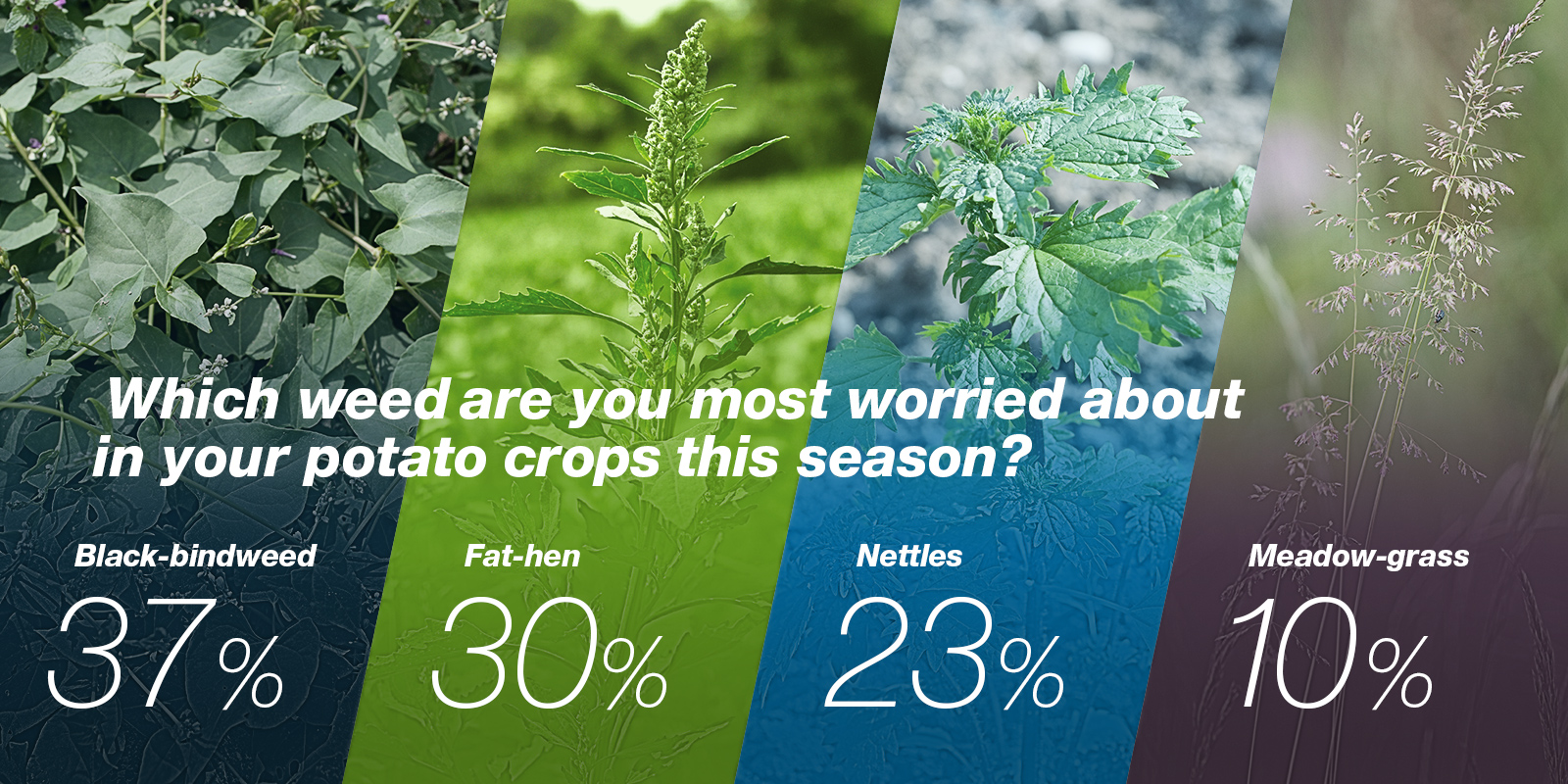
Black-bindweed (Fallopia convolvulus) is the weed that most concerns potato growers. In a poll of growers on the social media platform Twitter, more than a third of the 1,700 people who responded selected black-bindweed ahead of fat-hen (Chenopodium album), nettles (Urtica spp.) and annual meadow-grass (Poa annua) as the weed that most worried them this season.
That black-bindweed should top the list is unlikely to come as a surprise to many growers. This invasive weed is well-adapted to a range of climatic conditions and soils. It is a prolific seed producer able to generate up to 30,000 seeds per plant. It is deep rooting, grows rapidly and can scramble as high as the supporting vegetation will allow.
A serious weed in most arable crops it is distinguishable from Field-bindweed (Convolvulus arvensis) by its long cotyledons with short stalks while field-bindweed has oval cotyledons, notched at the tip.
Achieving control
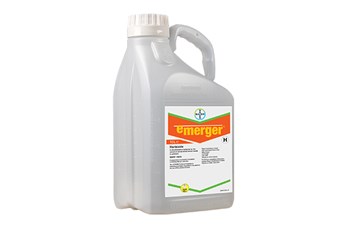
Achieving control in spring crops can be more difficult than in cereals, especially in dry conditions where the performance of some residual herbicides can be impaired. In potato crops, the Bayer pre-emergence herbicides Emerger (aclonifen) and Artist (flufenacet + metribuzin) have been found to deliver good activity against black-bindweed making both products a useful component of a weed control strategy.
Fat-hen
The annual dicotyledon Fat-hen is another broad-leaved weed well-known to arable farmers. As a weed that prefers cultivated land it has a similar distribution to black-bindweed though is perhaps less common on roadside verges. At 30% of the votes in our poll, it is a close second to black-bindweed in its significance to potato growers.
Fat-hen is a serious weed in almost all winter-sown crops and is common in sugar beet, potatoes, maize and cereals. In sugar beet its impact on yield can be considerable through crop shading while in other crops its impact can be measured more easily through the large quantities of nutrients it extracts. It favours moist, high-nitrogen loams and sandy soils. It has a large seed dispersal with about 20% germinating immediately with the reminder able to remain dormant for many years. Research has shown that in winter wheat 20-49 fat-hen plants per square metre can cause a yield loss of 5%.
Control
Controlling fat-hen before it can shed its seed is central to controlling this weed in the long term. In cereals, this is most easily achieved with a broad-spectrum herbicide, such as bromoxynil + diflufenican, mecoprop-p, or those containing a mix of dicamba + CMPP or MCPA.
In potatoes, control is less complicated. Both Emerger and Artist deliver effective control of fat-hen when applied at the pre-emergence stage. For late-geminating fat-hen, the effective herbicide options are restricted to metribuzin and carfentrazone-ethyl though the latter should be applied no later than 10% crop emergence which limits its value in such circumstances.
Nettles and annual meadow-grass
Of less concern to growers were nettles and annual meadow-grass with each receiving 23% and 10% of votes, respectively. While these can be troublesome weeds in potatoes, they are comparatively easy to control compared with both black-bindweed and fat-hen.
Edward Hagues, Bayer root crops campaign manager, shares the concerns of growers in controlling difficult weeds such as black-bindweed and fat-hen, but urges growers to remain positive.
“Black-bindweed and fat-hen have always been a challenge. Even linuron had its limitations and while glufosinate and diquat were effective as contact herbicides, they were often preferred as desiccants. Emerger has shown useful activity against these weeds, but it needs to be applied to fine, uniform seedbed to be truly effective,” he says.
“Artist’s effectiveness against annual meadow-grass and small nettle has been recognised for many years and containing both flufenacet and metribuzin, it is the only co-formulation available making it the perfect complement to Emerger in producing a three-way mix for broad-spectrum control,” he adds.