What’s happening in fields in the East this February
Suffolk-based Ella Crawford offers advice on keeping the number one oilseed rape disease at bay and maintaining good grass-weed control in wheat crops this month
Be aware of latent light leaf spot infection in oilseed rape
Use a light leaf spot fungicide as soon as possible where disease is present
Monitor wheat disease and plan fungicide strategies based on risk
Clear up surviving grass-weeds with contact herbicides
In Suffolk, milder and wetter weather in January has put spring crop preparations on hold and the recent drop in temperature has also slowed any winter crop growth.
Oilseed rape
There was some forward oilseed rape crops pre-Christmas, which the cold and frosty weather has helped knock back. It’s also checked aphid and cabbage stem flea beetle larvae activity and may have slowed disease progression.
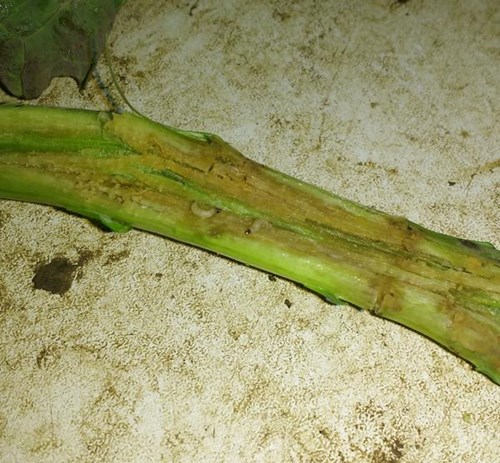
Cabbage stem flea beetle larvae
Results from SpotCheck samples sent in to ADAS have uncovered latent light leaf spot infection in susceptible varieties, driven by wet weather in January. We would expect to see some of that latent infection develop into visible lesions in the coming weeks and growers should continue to monitor for signs of the disease – particularly early drilled crops.
There is no threshold for treatment pre-stem extension, so as soon as its seen, a light leaf spot-active fungicide such as Proline (prothioconazole) at 0.32l/ha should be applied at the earliest opportunity.
While it is tempting to hold off and combine light leaf spot control and PGR activity in one spray, this can allow light leaf spot to become established and harder to control. Where disease does become established, the Proline rate can be increased to 0.46l/ha. Any Proline application will also top up phoma control and reduce stem canker development later in the season.
Cereals
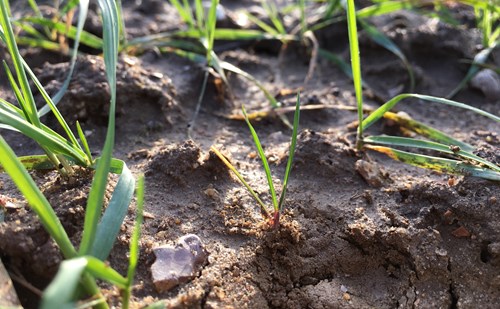
Growth stages in wheat range from those just emerging behind roots to the most advanced at GS26. The most advanced winter barley crops also have up to six tillers.
Despite the colder conditions, septoria and mildew are evident on older leaves of wheat crops, however recent frosts have knocked back rusts in places. Fungicide application isn’t usually required before the T0 timing in March, but disease progression is something to keep an eye on. It is a good time to make a note of current disease levels and plan for the T0 timing based on risk factors such as variety and drill date.
Barley is slightly different in that there is more emphasis on disease control earlier in crop development, with tiller survival crucial for final yield. It is a good idea to monitor for mildew, rusts and net blotch and treat with a T0 fungicide where pressure is high to maintain tillers numbers.
In Suffolk, growers didn’t shy away from heavy stacks of autumn residual herbicides in wheat and the longer half-life of actives such as flufenacet and DFF has meant overall, grass-weed control has been good. Any remaining black-grass and rye-grass is still small.
Growers should monitor the black-grass left behind and if a post-emergence herbicide wasn’t applied pre-Christmas, an application will be required as soon as the temperatures pick up and there is active weed growth.
Black-grass
There are a range of options, including Atlantis (iodosulfuron + mesosulfuron), Pacifica (iodosulfuron + mesosulfuron) and Monolith (mesosulfuron + propoxycarbazone). Choice will depend on your target weed. For black-grass and other grassweeds, Monolith will be the best choice, as it will give on average 10% extra control of black-grass over Atlantis WG. For situations where broad-leaved weeds are a problem, Atlantis or Pacifica are preferred options, as they have more tank-mix flexibility when adding in other broad-leaved weed herbicide partners.
Sugar beet
The sugar beet crop is about three-quarters lifted and yields have continued at record-breaking levels throughout the campaign, with 100t/ha not uncommon. Sugar content has also been good, averaging 17.8%. Those that used a third fungicide to control the late rust and cercospora epidemic have certainly seen a benefit this year.
Local technical updates
See all of our latest agronomy advice from across the country
We would like to use optional cookies to better understand your use of this website in order to improve our website. Your consent also covers the transfer of your Personal Data in unsafe third countries, especially the U.S., involving the risk that public authorities may access your Personal Data for surveillance and other purposes without effective remedies. Detailed information about the use of strictly necessary cookies, which are essential to browse this website, and optional cookies, which you can reject or accept below, and how you can manage or withdraw your consent at any time can be found in our Privacy Statement