Changing climate highlights urgent need for new varieties

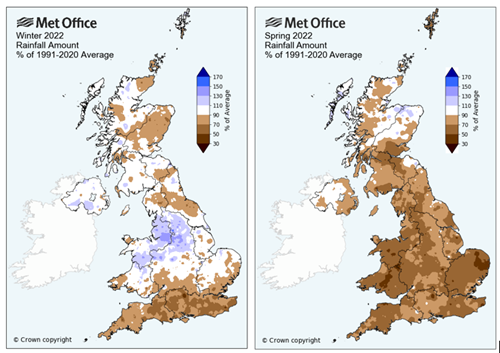
At 174mm – or 76% of the 30-year average – the UK has experienced the third driest spring since 1991 and the 36th driest since records began in 1851. This follows a drier-than-average winter which at 322mm – equivalent to 94% of the 30-year average – was the 17th driest since 1991.
The national situation was supported by below average rainfall across all regions of the UK. East Anglia, historically the driest area of England, received just 59% (74.7mm) of the average spring rainfall for the 30-year period to 2020 while Scotland as a whole received 87% (265.9mm).
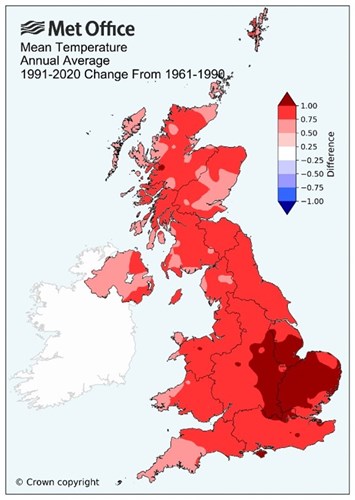
More sporadic rainfall is only part of the picture of the UK’s changing climate. Temperatures too, continue to warm. Analysis produced by the Met Office reveals that across all months of the year and regions of the UK, temperatures are increasing. As the image below depicts, the average temperature for the 30-year period between 1991-2020 was 0.9oC warmer than the preceding 30 years (1961-1990).
The combination of more variable rainfall and warming temperatures is likely to impact agriculture, and potatoes specifically, in a range of ways, observes Antonia Walker, Bayer campaign manager for roots.
“More mild weather will increase the risk of severe pest and disease damage while high-evaporation rates will require crops to be irrigated more frequently and for longer periods. Both will lead to higher production costs,” says Antonia.
One consequence will be the need for varieties better able to cope with more challenging growing conditions.
“Take common scab (Streptomyces scabies) as an example. Maintaining the soil moisture balance can be a challenge in the best of times, but drier weather through the main growing months will make this more difficult. Add in the pressures of water reform and loss of abstraction volumes and growers will find that diseases they used to be able to control with relative ease will become a greater nuisance,” says Antonia.
Of the 324 varieties listed on the former AHDB Potatoes variety database, less than half (156) have a common scab disease resistance rating of 6 or higher. Maris Piper, the most widely grown variety in the UK, has a score of 1. For late blight (Phytophthora infestans) the situation is worse. Just 32 varieties have a resistance score for foliar blight of 6 or higher. In the absence of a maintained variety database from AHDB, the Scottish Advisory Service for Agriculture (SASA) has produced a database of European varieties that also has a wider range of criteria to support more detailed assessments.
“The uncomfortable reality is that we simply don’t have the range of varieties needed to meet the production challenges of the future. We desperately need new varieties with durable resistance to a broad range of pest and disease threats as well as tolerance to crop stresses such as drought and high temperatures. These traits will be essential if the industry is to prosper in an era of tighter regulation, fewer plant protection products and higher production costs,” says Antonia.