Speaking at the 2022 Bayer vegetable conference, Simon Jackson of Allium & Brassica Agronomy considered how programmes might evolve to feature biologicals and other novel forms of pest control.
“The focus needs to be on preserving some of the products offering systemic activity for later in the season. To achieve this we will have to consider the use of biological and physical acting products at points in the season when pressure is less intense,” Mr Jackson said.
He conceded that developing such a strategy was still a work-in-progress but acknowledged there was little alternative if quality and yields were to be maintained. The difficulty was in knowing when to incorporate biologicals and physical acting forms of control without compromising control.
Contact acting insecticides such as Flipper (fatty acids C7-C20) and other biologicals are best incorporated into a strategy as part of a preventative policy as they do not offer the same high-level control of a systemic product such as Movento (spirotetramat).
In practice, this often means applying earlier in the programme when open canopies improve the chances of hitting the pest and before colonies start to build. Conditions at application and its timing have also been found to be important to the performance of contact only insecticides but some growers have yet to embrace these learnings.
“The pest challenge varies from year to year, but the difficulty in maintaining protection is becoming increasingly hard due to the continued loss of products. In aphids especially, it seems as though we are unwinding 20 years of progress and returning to a situation we last encountered at the turn of the millennium,” he said.
The gaps in protection vary according to the crop while the trade-off between using cyantraniliprole as either a pre-planting drench or as a foliar spray is a judgement the grower will need to make based on the growing period and perceived threat pressure.
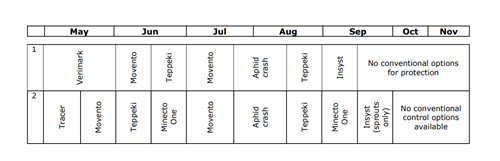
“Without Movento in broccoli, cauliflower, Brussels sprouts, cabbage and kale we would struggle; it needs to be used strategically. We also have Teppeki (flonicamid) and Insyst (acetamiprid), but not in all crops. Minecto One (cyantraniliprole) used against caterpillars has shown some activity against aphids, but its use is limited where Verimark 20 SC (cyantraniliprole) is used as a pre-planting module drench,” Mr Jackson said.
“Which product to use as a drench is an important decision as it determines how programmes are structured. The implications are most evident at the late-season stage when crops would be unprotected without the use of biologicals or physical acting means of control. A mild winter in 2021/22 points to an early aphid flight which would suggest a preference for Verimark 20 SC (cyantraniliprole), at the start of the season,” he said.
The products available and the limitations on use mean that there is, potentially, a six-week period at the end of the season where crops would be unprotected. To emphasise the point, he presented an example programme for a long season crop such as Brussels sprouts where protection would be needed for up to 30 weeks.
Aphid control programmes in long season brassicas (Brussels sprouts)
Assumes crop planted in May and harvested in November
Source: Allium & Brassica Agronomy
“Finding a window in the season when there is an opportunity to incorporate a biological will involve a more informed assessment of the threat facing crops, if growers are to have confidence in their ability to protect crops,” Mr Jackson said.
In kale, for example, the control options are more limited as Verimark is not authorised for use. In short season brassica crops, namely cauliflower and broccoli, the situation is less restricted as Verimark or Tracer can be used.
“For caterpillar control the product choice is a little broader, but gaps remain in kale and, to a lesser extent, broccoli. Pyrethroids are effective against Silver Y moth (Autographa gamma) and large white butterfly larvae (Pieris brassicae), but diamond-back moth (Plutella xylostella) presents a challenge due to wide-ranging resistance. The use of pyrethroids is also contrary to the principles of an IPM policy as they are harmful to beneficials. This raises further questions as to how we deliver sustainable control of insect pests,” Mr Jackson said.
Emerging threats
While growers are familiar with the threat posed by established pests such as virus-carrying aphids and caterpillars, a warming climate is helping other pest species to spread further.
“Larvae of the swede midge (Contarinia nasturtii) pose a threat to many brassica crops and with three generations a year, it can be a serious pest. It is largely a local and sporadic threat but is spreading east. It can be controlled with pyrethroids, but it is often difficult to manage. It is one to watch closely,” Mr Jackson said.
“We are also seeing more evidence of the late cabbage root fly (Delia radicum) damage. This tends to be in the form of ‘hot spots’ in crops, namely Brussels sprouts and broccoli. In periods of dry weather, the risk of damage increases significantly,” Mr Jackson observed.