Yellow rust is becoming less predictable. New and more aggressive races are emerging at a local level and these may tolerate a wider temperature range.
Yellow rust loves cool and damp conditions which makes March and April the usual time to see infection in the crop and disease spread. However, these new and more virulent races of yellow rust mean that the threat is continuing for longer with the disease continuing to cycle even when temperatures increase.
Weather forecasts are still not accurate more than two weeks ahead which makes it hard to plan fungicide strategies far in advance. Adapting to the current situation is key.
In addition to new races of yellow rust varietal resistance has come under pressure with previously robust varieties experiencing significant disease in recent years. Varietal resistance is now less predictable with Recommended List disease ratings not giving the full picture and making it harder to decide which fungicide strategy to use.
Rapid Disease Detection is a new technology from Bayer which will help growers identify latent yellow rust and Septoria in the crop before it is visible on the leaf surface. This information will help to inform and justify fungicide decisions.
Adopting a preventative approach even on varieties where you would expect good resistance will help keep yellow rust in check, but attention must be paid to the persistency of actives.
Yellow rust cycles very quickly with as little as three days between infection and the production of new spores during ideal conditions.
When it comes to control of yellow rust, it’s important to consider both the persistency of the fungicide active used and the formulation. Most actives are best suited to either protectant or curative situations and there are few ‘all-rounders’ that offer both.
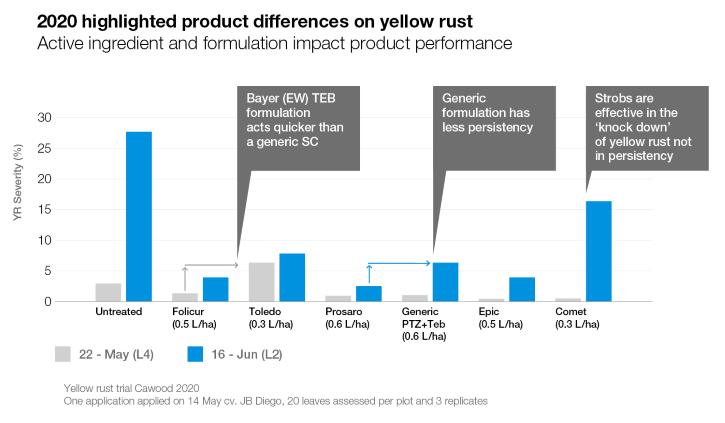
In general, strobilurins offer good curative activity against disease, but have shown to have limited persistency. Conversely, some fungicides with strong protectant activity struggle to control established disease.
When it comes to preventing infection and re-infection from yellow rust, benzovindiflupyr is known for providing the best protection over multiple disease cycles but is less effective when faced with established disease within the crop.
Strobs on the other hand work fast to control disease and this is an asset where yellow rust is already established in the crop. Where you have fast moving yellow rust cycles with disease present within the crop Strobs provide a good option. However, the movement of the active both on and through the leaf is limited which means it doesn’t provide good ongoing protection against reinfection.
The formulation of the product also affects its efficacy and that’s why the performance of tebuconazole, commonly used as a protectant fungicide at T0, can vary.
Trials at Bayer’s Cawood trial site in North Yorkshire showed that generic SC (suspension concentrate) formulations of tebuconazole didn’t act as fast as Bayer’s EW (aqueous emulsion) product, Folicur. Co-formulations can also suffer from variability and when Bayer’s EC (aqueous emulsion) co-formulation Prosaro was compared to a tank-mix of generic straight prothioconazole and tebuconazole the generic straights mix demonstrated limited persistency.
A well-timed fungicide programme that focuses on Septoria using robust rates and products will also control increasingly less predictable yellow rust.
Ascra offers all-round disease control in wheat. With its unique formulation of two SDHI fungicides – bixafen and fluopyram – and the leading azole fungicide prothioconazole, Ascra offers both protectant and curative activity on yellow rust and Septoria, plus good control of a range of other diseases. Ascra’s flexible dose rates enable you to match the rate to the disease pressure.