Nematodes have the potential to inflict significant damage to crops by feeding on plant roots, leading to reduced yield and quality. They are a perennial pest in a range of crops and effective management requires a suite of measures as actions taken to counter the threat posed by one species may not be effective against another.
For many years, growers have been encouraged to develop strategies that integrate all available measures and to think across the rotation to consider interactions between species and crops.
Research, both in the UK and internationally, has highlighted the need for a more determined approach to nematode control to safeguard crop quality and protect performance. Speaking at the Bayer vegetables conference in 2020, Professor Roy Neilson of the James Hutton Institute explained that laboratory testing had found Pratylenchus, a species of free-living nematode that affects both potato and carrot crops, in the lesions of tubers affected by common scab. “Although not evidence per se,” he said, “it suggests there is a relationship [between Pratylenchus and scab]”.
Alternative management strategies that utilise novel methods such as biocontrol agents, cover crops and antagonistic fungi have long been promoted as offering solutions for the long-term, but experience so far has been mixed.
Outside organic systems, conventional nematicides will continue to form the basis of a management strategy. Delivering this in practice, however, has taken on added difficulty given the loss of Vydate (oxamyl) leaving growers with Velum Prime (fluopyram) in carrots and potatoes and in parsnips through an extension of authorisation for minor use (EAMU).
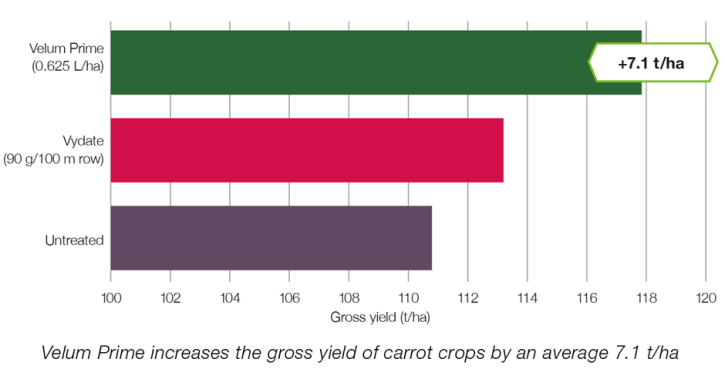
Velum Prime has demonstrated a level of yield protection in carrots that should give growers the confidence to continue without Vydate.
“Velum Prime delivered a total yield of 7.1t/ha more than the untreated compared with 2.4t/ha for Vydate. It also delivered a 7.5% increase in marketable yield over the untreated compared with 8% for Vydate through a reduction in fanging and stunting at sites selected for their high pressure. This is reassuring and should help ease grower concerns after the loss of Vydate,” Ms Matthewman says.
Source: Bayer, average of 15 replicated trials, 2012-18
Application best practice
All plant protection products work best when suitably applied and Bayer has been clear that this mantra applies as much to Velum Prime as it does other products. It has also repeated this message since it became the only nematicide for use in carrots to be applied as a broadcast spray via either a conventional boom sprayer or a boom mounted on a cultivator.
There are subtle differences in application practices that should be noted before Velum Prime is applied to carrots and parsnips that separates it from use in potatoes, advises Amy King, Bayer market development for potatoes, horticulture and fruit in the UK.
“In carrots, Velum Prime can only be applied as a broadcast spray. It must be applied in 250-500 L/ha of water and incorporated up to 72-hours before drilling,” Miss King explains.
In practice, incorporation to the required depth is best achieved using a rotavator-type cultivator, such as a bed-former or bed-tiller after de-stoning. Attempting to incorporate using a separator risks product dilution and banding. This would result in suboptimal distribution of Velum Prime through the bed profile.
“Cultivation practices are often significant to the performance of a nematicide and efforts to produce a quality seedbed will support efficacy. For carrots, a level seedbed constructed of a fine tilth will help promote even application and incorporation, ensuring Velum Prime is distributed through the bed profile accordingly,” Miss King says.
Contribution to Sclerotinia control
As a member of the SDHI group of active substances, it is perhaps not surprising that a reduction in the incidence of certain diseases might be observed following an application of Velum Prime.
Across 10 UK trials, where carrots received a soil application of Velum Prime with no foliar fungicides the incidence of Sclerotinia was seen to be down 32% relative to the untreated. In comparison, a conventional four-spray programme based on Signum (boscalid + pyraclostrobin) achieved a 52% reduction.
“Velum Prime must not be used to target Sclerotinia, but a contribution to control is welcome. Where Velum Prime is applied for nematode control it still counts towards the total foliar SDHI limit to the crop meaning that in order to comply with Fungicide Resistance Action Committee (FRAC) guidelines, the first foliar fungicide must belong to another mode of action,” Ms Matthewman says.