Review herbicide options for effective weed control

Posted 5 years ago
25/03/2021
Weed control is critical to the success of all crops and in most situations, herbicides remain the most efficient and cost-effective means of managing weeds. The loss of several broad-spectrum products, however, has created gaps in control that has led to an increase in production costs as more active substances are applied to achieve control.
All sectors have been affected to some extent, but horticulture, which is often reliant on off-label approvals through the granting of extension of authorisation for minor use (EAMU) permissions, has felt the impact perhaps more than most.
A report by Andersons, a consulting firm, in 2014 estimated that the opportunity cost of not controlling broad-leaved and grass weeds to be £110 million a year through reduced yields and lower crop quality. The exact impact varies depending on the crop being grown, but in outdoor lettuce, for example, the AHDB estimates financial impact to growers to be about £70m a year with a 50% loss in marketable yield.
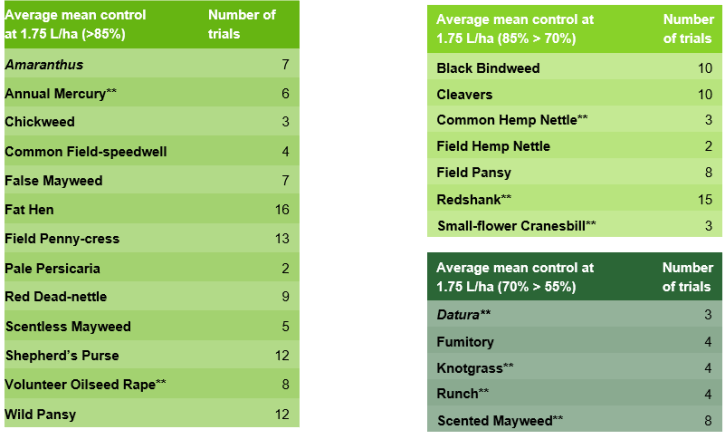
In some crops there is little choice. Emerger (aclonifen) is one of only a few post-planting herbicides authorised for use in stem vegetables such as celery, leek and salad onion. Fortunately, and as is highlighted in the table below, it offers a broad-spectrum with high efficacy against some of the harder to manage weeds.
It is also worth noting that where the weed burden is known to be high and if time allows, a pre-emergence application of Roundup (glyphosate) may be appropriate and could contribute to lower weed pressure later.
|
|
**Indicates the data contained for this weed is from a dose rate of 1.5 L/ha Emerger, due to reduced data being available at 1.75 L/ha. Increased control may be seen at 1.75 L/ha.
|
|
|
|
Average control taken from 2/3 trials, post emergence application only.
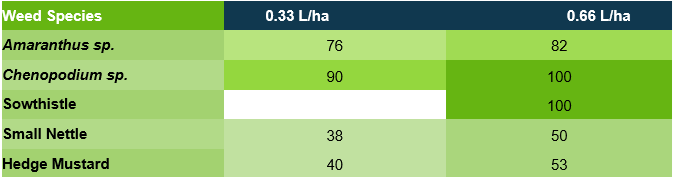
The situation is often better in other crops, but options for post-emergence control in carrots, parsnips and alliums remains limited. Depending on the weed species to be controlled, Emerger may need to be applied in a mix with other products.
In carrots, parsnips, onion, garlic and shallots, Emerger can be applied as a single pre-emergence spray up to a maximum 1.75 L/ha and 0.65L/ha as a post-emergence spray. In leek, celery, and salad onion, Emerger can only be applied up to a maximum dose of 0.65 L/ha.
Bayer anticipates that in carrots and parsnips a pre-emergence application of 1 L/ha followed by two sprays at 0.3 L/ha at one true leaf stage and again at two true leaves. As practices may differ between crops, growers should discuss how best to utilise Emerger with their adviser.
The use of Emerger on drilled onions, even at low application rates requires extreme caution:
Pre-emergence use of Emerger on sets is likely to be safer than on drilled onions though the application should be limited to 1 L/ha.
A tank-mix containing the following active substances has performed well in trials:
Prior to the loss of linuron, the standard pre-emergence mix for carrots was pendimethalin + clomazone + linuron. In trials similar weed control has been seen where Emerger was used in the place of linuron.