Bayer vegetable conference examines nematodes, insecticides and Brexit and what they mean for crop production

Posted 5 years ago
11/03/2021
The Bayer vegetable conference served up another technical briefing with details on how to make the most of biological insecticides the centrepiece of presentations while Bayer’s head of regulatory science gave an update on how Brexit presents an opportunity for a more proportionate and efficient system of regulating crop protection products
The biological insecticide FLiPPER has attracted great interest since being taken on by Bayer at the end of 2019. Feedback from those who have used it has been largely positive, but some of the questions being asked suggest growers need more information on its properties if expectations are to be fulfilled.
Speaking at the Bayer vegetable conference, Miles Taylor of FLiPPER manufacturer AlphaBio, reported that although FLiPPER is a biological, it is a relatively simple and effective solution close to that of conventional plant protection products. This convenience notwithstanding, the product does have a few key characteristics that are important to understand.
“Biologicals are a broad spectrum of crop protection products that can be quite different to what most growers are used to. We understand that the more information users are armed with the better the chance of reducing reliance on conventional applications,” said Mr Taylor.
Often the knowledge needed goes beyond the basic product description and into how performance can be influenced by the environment. In the case of FLiPPER (fatty acids C7-C20) the questions foremost in growers’ minds concern the effects of hard water and the safety of beneficial insects.
The impact of hard water is not an issue unique to FLiPPER as many herbicides are also widely affected, but it is how this effect occurs that is distinct.
With some herbicides, product performance is impaired when the cations (dissolved salts) in hard water bind with the chelates in the product rendering them biologically inactive. The effect on performance varies depending on the product being applied, time elapsed since mixing and the hardness of the water. In practice, the solution can still be applied, but the efficacy will be reduced as a proportion of the active substance is unavailable.
In the case of FLiPPER, the effect of hard water is more immediate. “In a normal mix, the solution will appear clear or milky white, but with extremely hard water, the formulation can separate which results in a process known as flocculation. This can lead to blocked nozzles and filters and reduced performance,” says Mr Taylor.
To counter the effects of hard water AlphaBio suggests adding a cation complexing agent to the spray tank to condition the water before FLiPPER is added.
“One water conditioner has been developed specifically for use with FLiPPER. X-Fusion® from De Sangosse is a non-acidifying water conditioner that has been found to be highly effective while Bayer has also conducted limited efficacy and selectivity testing with Align® from IntraCrop and Tri-sodium salt of citric acid (TSCA), which will be of particular interest to organic growers. Both are physically and chemically compatible with FLiPPER,” said Mr Taylor.
An alternative to water conditioners is to use soft water. Where groundwater is too hard, river water or rainwater collected from clean roofs could be a worthwhile alternative. This will be softer than ground water because it has not had the opportunity to collect metal ions such as carbonates, bicarbonates, sulphates, and nitrates as it passes through the network of reservoirs and pipes on its way to the tap or well.
Hard water is typically defined as water with a calcium carbonate (CaCO3) content of more than 300 mg/litre. Where the CaCO3 content of the water is found to be higher than this level, Bayer supports the addition of either X-Fusion, Align or TSCA.
FLiPPER is also physically compatible with a range of fungicides and insecticides but should not be mixed with some Bacillus thuringiensis and sulphur formulations as well as any products that contain fosetyl aluminium, myclobutanil, cypermethrin or metallic ions as these will lead to solubility issues similar to that seen with hard water.
FLiPPER is not the only biological insecticide to contain potassium salts of fatty acids, but it is safer to beneficial insects and pollinators than many of the alternatives. Many users wonder how this is possible.
The reason, explained Mr Taylor, owes much to the exact type of fatty acids contained in FLiPPER, the distinct nature of the pests being targeted, and the timing of any application.
“The work to identify those fatty acids that are effective against target organisms and are yet sufficiently safe to non-target organisms to receive an IOBC rating of 1 or 2 was extensive and extremely worthwhile. It is far more selective than other products also containing fatty acids.”
While not fully understood, the phytophagous nature of insect pests is thought to be a significant factor in supporting FLiPPER’s selectivity.
“FLiPPER works after making contact with the pest, but this is not its mode of action. Having investigated its multiple modes of action, AlphaBio believes the most likely reason behind its selectivity is its ability to inhibit the metabolic defence pathways of phytophagous insects leaving them susceptible to secondary plant chemistry. Work is underway to explore this and the findings will be made available once studies have been completed,” said Mr Taylor.
For those interested in seeing how FLiPPER compares with other biological insecticides containing potassium salts of fatty acids he encouraged them to use the side effects comparison tool at the Koppert website: sideeffects.koppert.com/side-effects/
FLiPPER may be safer to beneficials than many other biologicals, but it still comes with application restrictions.
“FLiPPER was found to have only a small impact on bees when directly applied but best practice is always to apply FLiPPER when bees or honeybees are not actively foraging. In practice, this means only applying at those times of the day when bees and other non-target organisms are not active in the crop.”
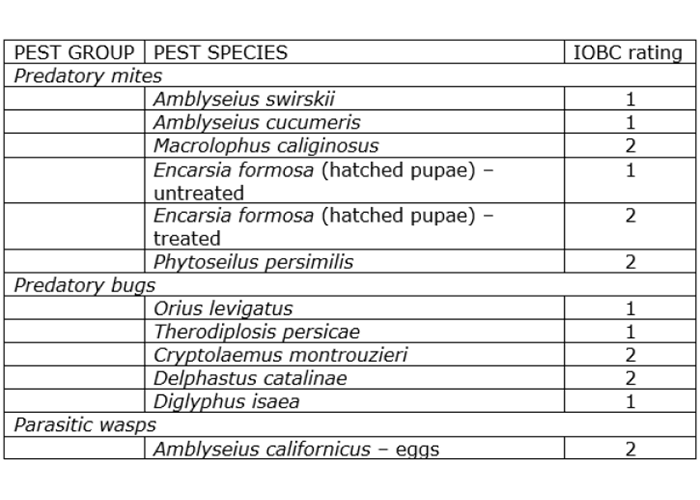
Source: IPM Impact Nederhespen, Belgium 2014
IOBC Rating
1 = Harmless or only slightly harmful <25% mortality
2 = Moderately harmful 25-50% mortality
It is widely accepted in the field of crop protection that the ability to apply the product directly to the point of need greatly increases the chances of success.
The accuracy in application needed varies according to the nature of the product being applied. In the case of systemic or translaminar fungicides, the plant serves to move the product to the point of need, but in the case of contact-only insecticides, success is often dependent on the application apparatus.
According to Tom Robinson, independent spray application consultant, roughly 50% of the success in hitting the target is under the control of the operator.
“Regardless of what is being applied, the product typically accounts for no more than 50% of the control achieved. Application timing (30%), equipment set-up (20%) and application technique (10%) make up the remainder,” he says.
“Of these, equipment set-up and application technique are the factors over which the operator can exert the greatest control,” he adds.
To make the most of this opportunity, what can growers do to maximise the performance of the products they apply?
It depends on the product being applied. Specifically, whether dose rate or coverage is the priority. In the case of contact-only insecticides such as FLiPPER (fatty acids C7-C20), coverage is the priority, but not at the expense of dose rate.
“In some cases, coverage can be improved by moving to finer sprays, but with this comes a loss of control. As a result, ensuring coverage is optimised means increasing the water volume, typically to no less than 400 L/ha,” he says.
Inclusion rate is important too and in the case of FLiPPER this should be no less than 1% of the spray volume. Hard water has been found to affect performance and so should be conditioned before the product is added.
“In most cases it is best to condition the water with an inline system but before entering the tank. Where this is not an option, about 90% of the water volume should be added to the spray tank and then add the conditioner followed by the product and the remaining water,” says Mr Robinson.
Having ensured that the efficacy of the product will not be impaired, application technique is the next single biggest concern. Nozzle choice is therefore fundamental to ensuring the product is applied where it is needed.
“Where insects are on the underside of the leaves, the spray needs to be directed upwards from underneath the canopy. There are several ways to perform this with drop leg systems being the most effective, followed by air assistance nozzles and last, angled nozzles.
“Where insects are deep in the crop, as is often the case with carrots for example, a high energy spray will be needed to give the penetration required,” he says.
Hitting the target is only one aspect of control and should always be considered alongside coverage and deposition. The two are quite distinct, in that deposition relates to the amount of active substance deposited on the leaf while coverage is the amount of surface area receiving treatment. Distribution refers to uniformity of the coverage.
Changing drop sizes therefore involves several trade-offs. In the case of FLiPPER, increasing coverage means increasing water volume, rather than switching to a finer spray.
“Increasing water volume is the single most effective way to improve the chances of reaching the target. With FLiPPER, coverage is the overriding factor, but spraying to the point of run-off is not good practice as the product leaves the plant and collects on the ground.”
There are two types of nozzle suited to FLiPPER application. “Small drop air inclusion such as Guardian Air give a good number of drops per litre, excellent retention and deposition and uniform distribution. The alternative is the fan jet. These give a higher drop numbers per litre but are less easy to control with poorer retention and deposition and less uniformity in distribution as a consequence. The hollow cone nozzles which give very fine sprays are not recommended as trials with vegetable crops found that the spray tends to go around the plants, and to drift.”
Angle direction can also support application. “A vertical fan jet tends to apply to the top and the front of the plant and not much more whereas angled nozzles give better coverage as the spray is directed around all sides of the plant.”
Where there is a need to apply to the underside of the canopy, drop leg systems should be considered. “If the target is on the underside of the leaf, drop leg systems are the best means of hitting them where a conventional boom sprayer is the only means of application available,” says Mr Robinson.
In orchards and soft fruit systems, mist blowers and air sleeve systems can be effective. “With mist blowers the air needs to be set up for the crop in question,” cautions Mr Robinson.
Velum Prime, the liquid nematicide containing fluopyram, has received regulatory authorisation for the control of free-living nematodes in carrots.
To assess its performance, Peter Saunders, agronomist for Alan Bartlett & Sons, described how the company put Velum Prime up against Vydate (oxamyl) at a high-pressure site at Swaffham, Norfolk in the 2020 season.
The trial involved inspecting 4,658 carrots from 90 plots but proved highly worthwhile with Velum Prime providing protection equal to that achieved with full-rate Vydate.
An article explaining the trial and the results produced can be seen on the Bayer blog here.
As DEFRA surveys attitudes on the use of gene-edited crops and livestock in England, it raises hopes that government will pursue a more liberal approach to technology, but it also raises questions as to how quickly it will diverge from European Union policy in other areas where rules were once set by the European Commission, such as crop protection.
There are signs that the Chemicals Regulation Division (CRD) and its parent body, the Health & Safety Executive (HSE), want to pursue a more proportionate and efficient regulatory system, says Janet Williams, Bayer Head of Regulatory Science for the UK, and Republic of Ireland.
“The EU regulatory process is overly complex and inefficiently repetitive, so leaving the EU is an opportunity to review this system to create a more efficient process that focuses on delivering answers to the scientifically and politically relevant questions. There is great potential to make the evaluation process in Great Britain far more efficient, without making it any less robust, and an attractive country in which to seek early authorisation for new active substances,” Mrs Williams said.
Although Great Britain (GB) is a relatively small market in global terms, a robust, but efficient regulatory system would raise its appeal to manufacturers that might otherwise question the cost of generating unique data for a small market. The GB evaluation also has the potential to be used as a basis for other Rest of World country evaluations.
“This is to GB’s benefit and, assuming its data requirements are not overly onerous, will support its appeal as a place to seek early product approval while potentially giving its growers early access to new products,” she said.
This is an opportunity the UK is yet to exploit but, in the meantime, it is hoped that there is potential for changes of a different sort in the more immediate term.
The policy instruments, 1107/2009 and 396/2005 set out the terms for reviewing active substances and plant protection product authorisations and were converted into domestic law as part of the transition arrangements introduced after the UK formally left the EU in January 2020.
“Although responsibility for active substances, formulations and maximum residue levels (MRLs) has been repatriated, the standards and technical requirements required previously have been retained,” she said.
“Whilst there will probably be divergence over time, these will only apply to Great Britain as EU pesticide regulations will continue to apply in Northern Ireland,” she added.
Maintaining unfettered access to Great Britain for produce from Northern Ireland (NI) has resulted in a two-tier system. The UK Internal Market Bill introduces the principal of mutual recognition, but this applies only to MRLs and only for produce heading to GB from NI, not the other way. Nor does it apply to plant protection products or active substances.
“The development of a new GB regime has implications for all parties. For manufacturers there is the need to consider both GB and the EU/NI when seeking product authorisation. For distributors there are potential stock management issues should a product lose its authorisation in GB or NI and for agronomists, users, and farm traders there will be the need to constantly check the MRL of a product if the target market is outside Great Britain, unless a new process is developed,” explained Mrs Williams.
Many HSE staff were seconded to work on Brexit preparations or the COVID pandemic and obviously, the usual issues arising from everyone having to work from home also are having an effect. Until any new GB system is implemented, these applications will continue to be assessed under the EU framework.
“The good news is that there will be public consultation on how a new review programme should work and it will continue to use assessments from other jurisdictions where they are relevant. Nor is there likely to be a significant divergence on standards. The CRD is widely respected as a regulator and we expect this professionalism to continue,” Mrs Williams concluded.
Please note X-Fusion® is a registered trademark of De Sangosse. Align® is a registered trademark of IntraCrop.