Take the flexible approach to PCN control with Velum Prime


Velum Prime, the liquid nematicide containing fluopyram, offers a level of flexibility in application that is unrivalled amongst other forms of nematode control.
Potato growers can choose between applying Velum Prime in-furrow at the time of planting either as a standalone treatment or in co-application with Amistar (azoxystrobin) or Allstar (fluxapyroxad) if desired, or in sequence with Nemathorin (fosthiazate) should the situation require.
As an alternative to in-furrow application, growers have the choice of applying Velum Prime as a broadcast spray using a conventional farm sprayer or a liquid applicator fitted to cultivation equipment. The application and required incorporation can take place up to 72-hours before planting.
The flexibility in application method means growers can choose that which best fits their machinery and labour profile without fear of compromising efficacy.
The choice of application method further extends the versatility of a product that has done much to promote nematode control to situations where it was either not economically viable to use a granular product or where the short season nature of the crop precluded the use of a granule.
This is a win-win for growers. Across 22 replicated trials spanning nine years, the yield protection and PCN population management was broadly the same meaning growers can choose the method which best fits their existing cultivation and planting systems without compromising performance.
Velum prime: similar performance regardless of application method
|
|
Untreated |
Velum Prime: broadcast spray |
Velum Prime: |
|
Total yield (t/ha) |
32.2 |
36.8 |
35.6 |
|
Pf/Pi |
10.7 |
5.4 |
5.4 |
Source: Bayer, 2012-2021. Average results from 23 replicated trials
With little to separate the performance of either application method, the data were scrutinised to see if there were scenario specific conditions that would favour one method over the other. Neither soil moisture status or soil type were found to be significant to performance, but method and depth of incorporation are important when applied as a broadcast spray.
Growers should aim for an even distribution through the soil profile to a minimum depth of 10 to 20 cm, but up to 30 cm is supported. For this reason, Bayer does not advocate attempting to incorporate Velum Prime via de-stoning, which typically moves soil from a depth of 30 to 40 cm, or by the planter, which will fail to provide sufficient incorporation to the required depth.
If Velum Prime is to be applied by broadcast spray, the soil surface should also be as level as is practicably possible prior to application so as to ensure even distribution across the surface as this will then support even and consistent incorporation at depth.
Operator workload at planting will likely be a consideration for growers when choosing between application methods.
In-furrow application has the advantage of requiring a lower water rate – 100 L/ha compared with a minimum 200 L/ha for broadcast spray – meaning it can be applied at the same time as Amistar (azoxystrobin) for improved yield protection in the presence of tuber diseases. In contrast, the principal advantage of application by broadcast spray is that it can be done ahead of planting.
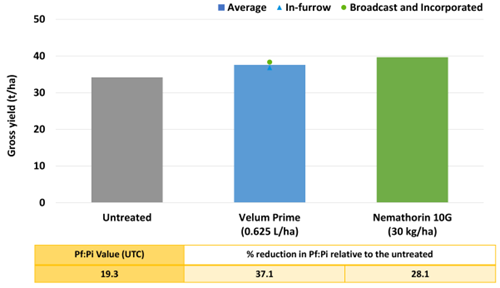
In high-pressure situations, Velum Prime gives extra yield in sequence with granular nematicides
Source: Bayer, 16 UK trials, 2016-21; Pf/Pi results from 15 UK trials, 2016-21