Emergency authorisation lifts hopes of a good sugar beet crop

Posted 5 years ago
25/01/2021
The emergency authorisation for Cruiser SB has raised hopes that sugar beet crop will not suffer the same impact from virus yellows as seen in 2019/20
DEFRA has granted an emergency authorisation for the use of thiamethoxam, the active substance contained in Syngenta’s neonicotinoid seed treatment ‘Cruiser SB’. The news will do much to restore confidence to a crop where growers had reported yield losses of up to 80%, but there is a caveat: for the seed to be treated, the risk to the crop needs to breach the threshold set by the Rothamsted Aphid Forecast. The forecast, as published on 14th February, needs to indicate that the more than 9% of the crop area will succumb to virus infection. This is the threshold above which economic losses would be incurred.
There will be some for whom the news is of little consequence. Those on rented land where their arrangements prohibit the use of neonicotinoid treatments, those for whom the restrictions on following crops are considered too onerous to observe and those with fodder and energy beet which are not included as part of the derogation to ensure the ‘controlled and limited’ element of the authorisation will no doubt be hoping for foliar control alternatives.
While most growers will welcome the news, it comes with further conditions. The principal restriction being the application rate will be below the normal commercial rate to reduce the residual amount in the soil. This lower rate of 45g/kg of seed is 25% lower than the standard rate and was proposed by the British Beet Research Organisation (BBRO) as a means of alleviating concerns that the residual concentrations posed a risk to non-target insects in subsequent seasons.
“The lower application rate should be sufficient to provide 10 weeks protection against virus yellows,” says Professor Mark Stevens, BBRO lead scientist.
“Where crops need protection beyond the 10-weeks provided by Cruiser SB, a single application of the foliar spray Teppeki (flonicamid) can be applied up to 60 days before harvest,” Professor Stevens adds.
Other significant conditions concern weed control, specifically that flowering weeds appearing in and around treated crops will be effectively controlled.
There are also restrictions on the crops permitted to be sown in following seasons. Only cereal crops can be sown within 22 months of Cruiser SB-treated seed being sown and no oilseed rape within 32 months. Another condition is that the seed rate must be limited to that needed to achieve a normal plant population.
The BBRO stresses that the application of thiamethoxam is just one part of a programme of measures to protect crops from virus yellows. Growers too are expected to act responsibly by removing sources of potential infection, drilling into good conditions and close monitoring of the crop through the season. To support growers, the BBRO plans to publish a five-point plan detailing how growers can protect their crops. It has also committed to continuing its own work and its role in supporting others in to finding a long-term solution to the threat of virus yellows based on natural plant resistance.
The 2020 season was one of overwhelming virus pressure in all factory areas and fear that this would be repeated in 2021, provided the basis for the BBRO’s application for a derogation.
“On a national scale, the incidence of virus yellows during the 2020 season was 38%; this was the highest since the mid-1970s,” Professor Stevens says. The range in virus incidence varied depending on the factory area, from 8% in the Cantley area to 68% around Wissington with crops around Bury St Edmunds and Newark suffering infection of roughly 30%.
In granting the derogation, however, it may be that ministers went against the advice of the government’s lead scientific adviser, the Health & Safety Executive (HSE).
In the minutes of the November 2020 meeting of the Expert Committee on Pesticides, of which the HSE is a member, it is noted that while the HSE accepted that the industry had a valid case of need for thiamethoxam, it believed the risks to non-target organisms could not be sufficiently mitigated. Nor did it consider as significant the decision of other EU states to grant a derogation as relevant to the scientific evidence.
The authorisation was met with “extreme disappointment and concern” by the British Beekeepers Association which highlighted the drought of spring 2020 as contributing to a poor year for all broadacre crops.
“It is particularly concerning that this derogation may continue for two more years. It is to be hoped that any such decision is discussed more fully especially since the farming press in the autumn did not indicate any more dramatic effects on the crop in 2020 when compared with a range of other crops all struggling with an exceptionally difficult year from problematic weather conditions.”
The dry spring of 2020 meant rainfall in East Anglia was just 40% of the long-term average and ensured the sugar beet crop endured a prolonged period of crop emergence. For every week in April that crops don’t emerge, yield is reckoned to be reduced by 8%. Add in virus and late-season diseases such as Cercospora leaf spot and the impact on yields is clear. Growers can hope that news of the derogation comes with a kinder season in 2021.
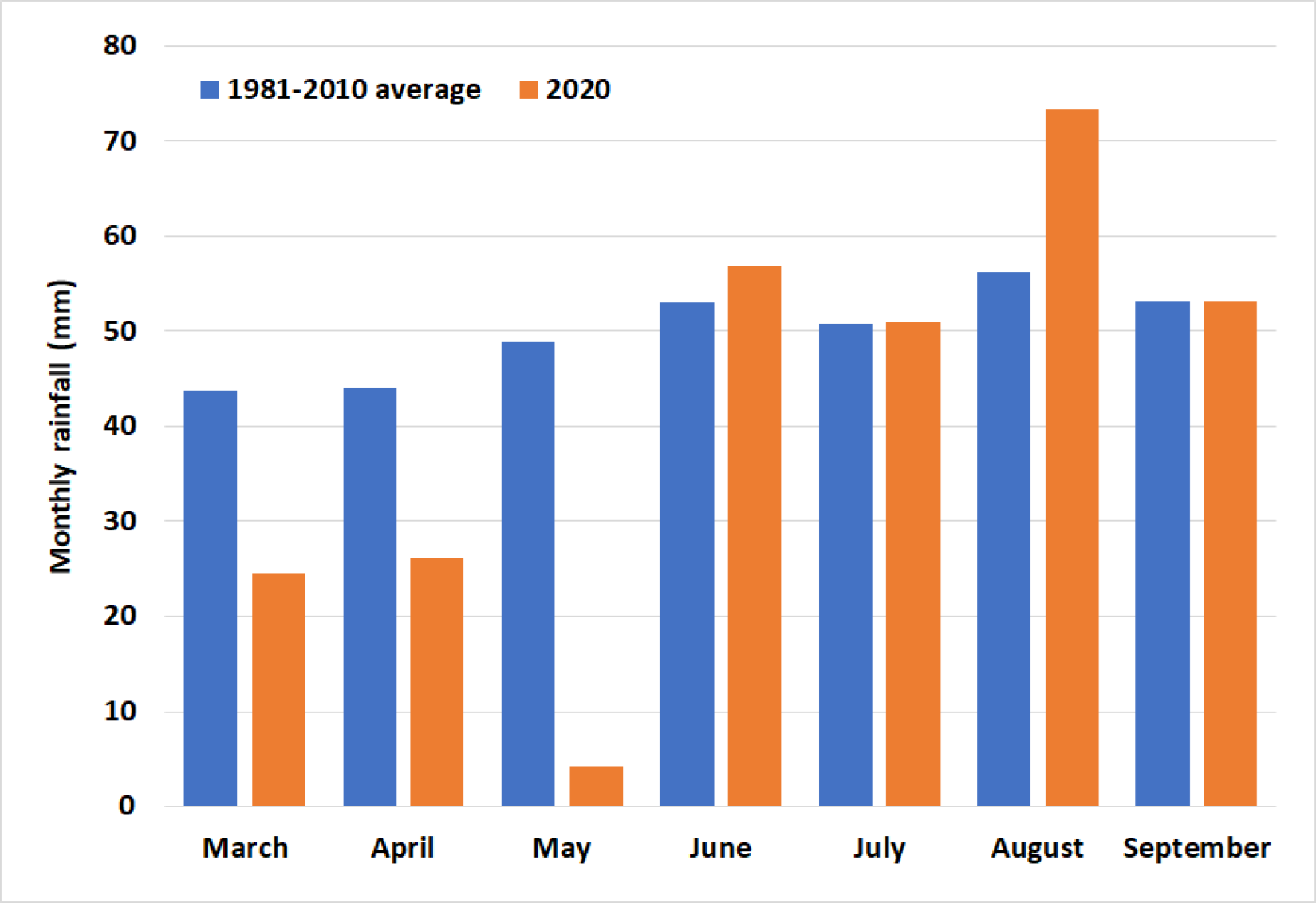
East Anglia received just 40% of the average spring rainfall in 2020
Source: Met Office
Belgium, Spain, Poland and, most recently, three regions of Germany, have also announced derogations allowing the use of neonicotinoid seed treatments in sugar beet in 2021. The Swiss government refused an application made on similar grounds to that approved in France.