4 things we learned from our grassweed resistance quiz
The results are in from our grassweed resistance quiz. Over 200 people completed the quiz, which was based on the excellent Ultimate Guide to Herbicide Resistance. The guide provides a lot of detail about all aspects of herbicide resistance from how it develops, the different types, testing and how to manage it.
Here are our four learnings from your answers to the quiz.
1)Virtually no one is a resistance expert
Only 8% of the 200+ quiz-takers scored over 80% in the final reckoning, which suggests there is still some way to go before we are all herbicide resistance experts.
There is some mitigation though. Some of the questions were set at perhaps the degree level of difficulty, requiring an in-depth knowledge of the history of resistance development, and while some were not answered overwhelmingly correctly, most people were in the right ballpark.
For example, only 28% correctly answered that 13.2% of agricultural production was lost to weeds worldwide each year, 81% of you knew that it was at the upper end of the answers we suggested which ranged from <1% to 18.5%.
2)Key practical management tactics are widely understood
The good news was that understanding of the key practical tactics for limiting resistance development were much more widely recognised.
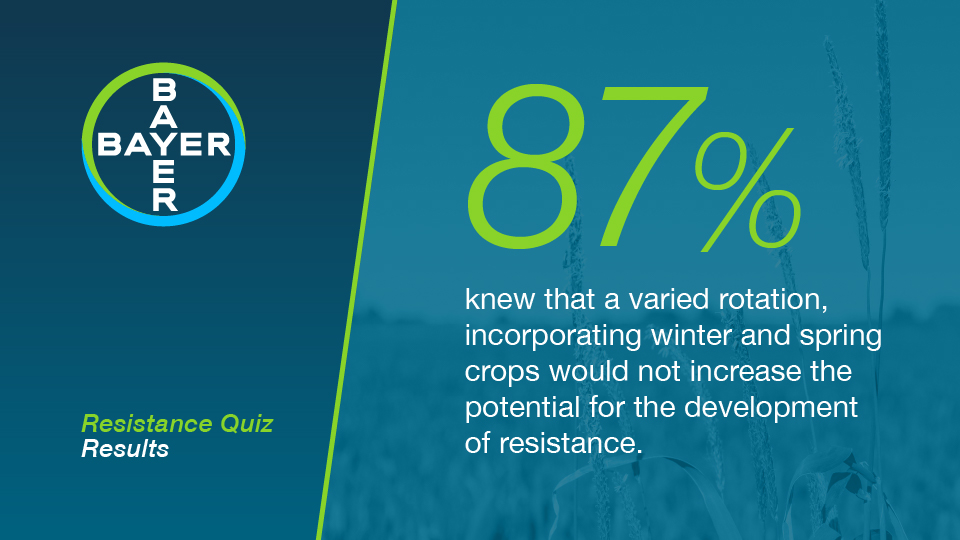
87% of those taking the quiz knew that a varied rotation, incorporating winter and spring crops would not increase the potential for the development of resistance, meaning the wrong options of relying on chemistry alone, or a single mode of action, or a high level of weeds were mostly avoided.
Other options for delaying resistance detailed in the Guide include using a variety of cultural, mechanical and chemical weed control options, maintaining low weed levels, and if you are using herbicides, trying to use multiple modes of action in mixes or sequences and maximising efficacy by following application guidelines and label recommendations.
3)Uncertainty over how quickly resistance develops
It probably felt like a bit of a maths question, but the question asking if there were just 0.0001% of resistant individuals in a weed population, how many applications of a herbicide would there need to be before there would be over 50% resistance assuming no other control measures, left a lot stumped.
Nearly half of quiz-takers felt that it would be either 10 or 20 years before that level of resistance would be seen. Only 45% correctly said it would be just 5 years.
It’s a key point, particularly for growers who currently feel they don’t have a resistant weed problem, for example of black-grass, rye-grass or brome. In the Ultimate Guide to Herbicide Resistance, there is a graphical representation of how quickly resistance can build, particularly from year 3 (0.29%) to year 4 (4.22%) and year 5 (60.5%).
It’s critical for managing weed resistance that these crucial first signs of resistance building are recognised and reacted to before you get to having populations with that level of resistance to help keep fields in profitable production.
4)Do you know which type of resistance you’re dealing with?
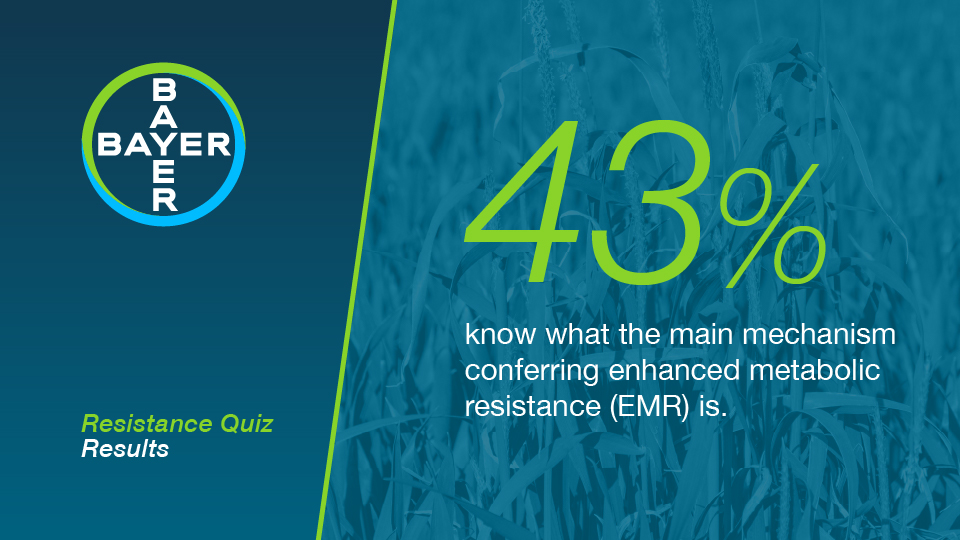
Perhaps a little surprisingly only 43% of respondents knew that the mechanism of one of the main types of resistance – enhanced metabolic resistance (EMR) – was that the herbicide was degraded before it reaches the binding site.
Nearly as many incorrectly thought it was due to a structural change in the target binding site, which is the main mechanism for target site resistance (TSR).
Knowing the difference between the two is an important consideration for understanding whether a particular herbicide will be effective, partially effective or not at all.
For example, target site resistance often results in very poor herbicide efficacy from the specific mode of action affected and can increase quickly within resistant populations. Enhanced metabolic resistance, on the other hand, usually only gradually increases over time, but affects most herbicides to varying degrees.
Understanding this difference when you get a resistance test done is helpful for interpreting the results and what tactics to employ in future.
For more detail on different types of resistance, how resistance tests work and their interpretation download the Ultimate Guide to Herbicide Resistance.
We would like to use optional cookies to better understand your use of this website in order to improve our website. Your consent also covers the transfer of your Personal Data in unsafe third countries, especially the U.S., involving the risk that public authorities may access your Personal Data for surveillance and other purposes without effective remedies. Detailed information about the use of strictly necessary cookies, which are essential to browse this website, and optional cookies, which you can reject or accept below, and how you can manage or withdraw your consent at any time can be found in our Privacy Statement