10 insights into how cabbage stem flea beetle attacks are being tackled on farm
Cabbage stem flea beetle has almost singlehandedly halved the oilseed rape area in the UK. So, what did the Bayer Cabbage Stem Flea Beetle Management grower survey say about how it is being tackled?
It has been another difficult year for oilseed rape growers battling the beetle. Cabbage stem flea beetle is the main driver of a crop area reducing from over 700,000ha before the neonicotinoid ban to nearer 370,000ha for 2020 harvest. And that looks set to drop further next autumn.
Yet the ingenuity of growers around the country is starting a fightback. Plans have been put in place. New techniques are being tried every year. And research is starting to make potential breakthroughs.
But how much success are growers having currently? That’s what the Dekalb team at Bayer attempted to find out with a first-ever national grower survey this spring. The aims were threefold:
Establish the current impact of cabbage stem flea beetle on farms across the country
Investigate the techniques being used by growers to manage the threat from the pest in 2019/20 and their relative success
Provide the best possible pointers for management improvement in 2020 and beyond
The survey attracted 215 responses from growers across the country via either Bayer’s social media channels, email or The Farming Forum.
Here are our 10 key insights
1. Cabbage stem flea beetle is having a major effect on the survival of oilseed rape crops
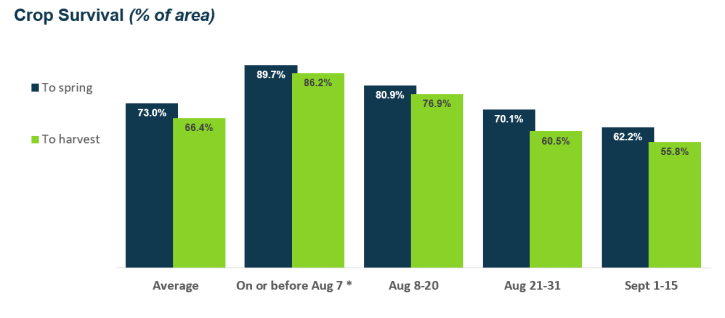
Well, duh, right? But the level of the problems was laid stark by the survey. By area 9% of crops had to be re-drilled, just under three-quarters (73%) made it through to spring, while two-thirds (66%) were going to make it through to harvest.
Regionally within those figures there are some variations. Breaking respondents down into 3 broad regions – the North (Yorkshire & Humber to Scotland) is clearly a less difficult place to grow oilseed rape currently. Nearly 75% of crops survived to spring, and virtually all of those (73%) were going to be harvested, with Scottish growers (albeit in limited data) reporting over 90% for both.
Move into what most would have considered the hotspot cabbage stem flea beetle areas of East Anglia, East Midlands and South East England, and spring survival drops to 66.5%, while only 57.5% of crops look like being combined.
But it is the growers in the West Midlands, Wales and South West that reported the lowest spring survival rates (59.7%) and harvest chances (55.5%). In the early years post-neonics those regions seemed less hard-hit – that is no longer the case.
2. Intensity of cabbage stem flea beetle is important
In case you’re in any doubt the difference in survival rates between crops suffering substantial or intense pressure versus those facing only moderate or better infestations was enormous. According to the survey responses, only 5% needed to be re-drilled under low pressure, with nearly 90% going onto to be harvested, compared with 13% needing to be re-drilled, and less than 50% being harvested.
3. Lack of moisture exacerbated problems but wasn’t as big a factor
A lack of moisture made a bad situation a little worse, but ultimately intensity of cabbage stem flea beetle attack was the driving force behind crop failure. Just over 1% more crops needed to be re-drilled when they were drilled into lower moisture conditions and faced high levels of CSFB attack, and around 7% fewer made it to spring.
But the results shouldn’t underestimate the importance of trying to drill into conditions that will promote fast establishment, and moisture plays an important role in that. That was highlighted by overall 25% more crops drilled into decent moisture in the 8-20 August window being taken to harvest than those that weren’t.
4. Drill early for best chance of crop survival
There has been a lot of discussion about drilling early to try to avoid cabbage stem flea beetle adults chomping the crop. In the survey 37% of the crop was planted before Aug 20, and 75% before the end of August. Growers said the level of challenge from CSFB increased as drilling date was delayed.
Not surprisingly perhaps then the results suggest last season drilling earlier increased the chances of getting a crop away by avoiding the worst CFSB pressure and taking advantage of better soil moisture.
Re-drilling increased noticeably as sowing was delayed from a low of 3.7% from drilling in early August to 13.6% for September plantings. Similarly, 90% of early August sowings survived through to spring down to 62% for September drill dates, with a similar trend for crops being taken through to harvest.
5. But drilling early increases chances of spring losses
The downside to early drilling is that it increases the chances of crops going backwards and being lost in the spring.
Only 5% more crops were lost between spring and harvest from those drilled in September and were under substantial or intense cabbage stem flea beetle pressure. That compares with 11% for crops drilled in August.
Overall in that scenario, August drilled crops are about 5% more likely to survive to harvest, but September drilled ones are more likely to fail earlier, meaning you might have spent less on them and giving more time to decide alternative cropping plans.
6. Direct drilling or ploughing might be best?
Direct drilling came out on top from the three main establishment regimes used in the survey – direct drilling, minimum tillage and subsoiler seeding – with 64% of crops making it through to harvest compared with 55% of those established with a min-till system, and 58% for subsoiler seeding.
While only relatively low numbers were using a plough, those who reported using that system, were having much higher levels of success – with over 90% of crops making it to harvest. But the small dataset means this result needs treating with caution.
7. Hybrids outperformed conventional varieties
Yes, they’re more expensive and the risk of failure is still present, but the survey highlighted the role that hybrid varieties can have in overcoming cabbage stem flea beetle attacks. Overall, only 6% of all types of hybrid crops were re-drilled, 78% made it to spring, and 67% were going to be harvested, compared with 12% re-drilled, 67% to spring and 57% to harvest for open-pollinated varieties.
Hybrids were also perceived to both have lower larval levels and to recover better from larval attack by growers, averaging 5.8 on a scale of 0 to 10 (where 0 is crop written off, and 10 is no signs of damage), compared with 4.6 for conventional varieties.
With many hybrid variety breeders, including Bayer with its Dekalb Establishment Scheme, now offering some form of risk-sharing for growing their varieties, using hybrid varieties is worth considering to increase chances of success, while using establishment schemes can help mitigate against the extra expense.
8. Seed-bed fertilisers helped crops survive along with fast-developing hybrid varieties
The survey asked growers about some of the commonly used tactics being used to combat cabbage stem flea beetle attack. Ten of the techniques growers said they were using were common enough to be analysed, while companion cropping showed some promise from a small sample.
The most popular tactic employed was spraying with insecticides (68%) followed by growing fast developing hybrid or conventional varieties (63%), and using seedbed fertilisers (58%).
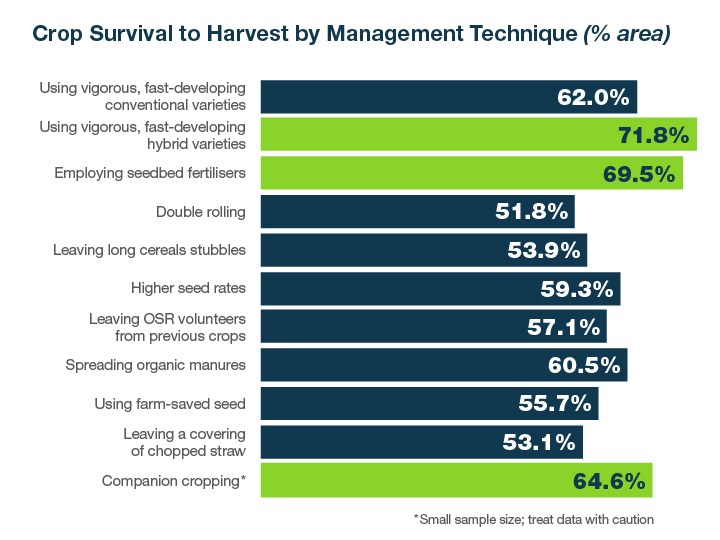
When assessed by the area of crop being taken through to harvest, two techniques stood out as being most successful: using vigorous, fast-developing hybrids (72% of crops being harvested) and using seed-bed fertilisers (70%).
Companion cropping sat at 65% in a small sample, while fast-developing conventional varieties (62%) and spreading organic manures (61%) were next best using this metric.
All other tactics were associated with less than 60% of crops being taken through to harvest, with double-rolling (52%) and leaving a covering of chopped straw (53%) least successful.
Another metric was asking growers to rate their establishment success. Again using fast-developing hybrids came out on top (6.66 on a 0-10 scale with 10 being perfect establishment), with companion cropping (6.98) on limited data also impressing. Overall there were only small differences between different tactics using this metric though.
9. Spreading organic manures help against larval attack, along with hybrid varieties
It’s not all about adult cabbage stem flea beetle attack, as we’ve seen in past seasons, when good crops go backwards in the spring as larvae attack the plant stems in spring. The survey asked for growers assessment of levels of larval attack and recovery from damage.
Growing fast-developing hybrids and spreading organic manures were the tactics most associated with reduced larval levels and least damage. Fast-developing conventional varieties scored well on lower damage, but not in numbers of larvae found.
10. Is perception reality?
The final assessment growers made in the survey was the success or otherwise of the tactics they were using. It’s an interesting comparison between their perception and the association of a tactic with the area of crop making it through to harvest. Both measures have some fallibility – a grower’s perception is just that, while the calculation of crop area makes an assumption of an association which may be just that.
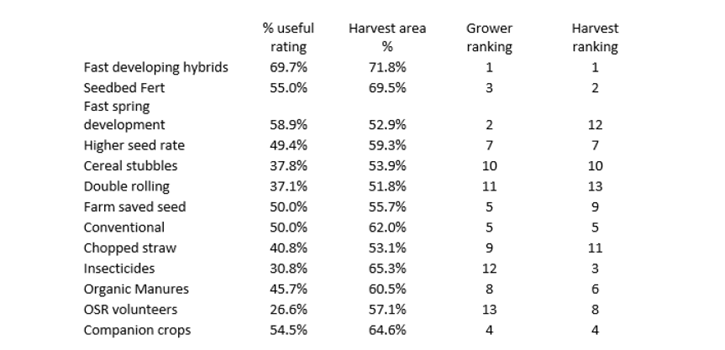
On both measures using fast developing hybrids come out on top – 69.7% rated the tactic as having at least some use (our scale for usefulness was some use 5-6, while useful was ratings between 7-9).
Using seed-bed fertiliser was also ranked in the top 3 by both measures, and would seem to make sense – anything that helps speed establishment intuitively seems right.
But then the lists diverge somewhat. Growers perceive varieties with fast spring development as being useful, yet the harvest success association is only 12th out of 13 tactics. For example, growers perceive using insecticides having little benefit to success, yet the harvest success association is ranked third overall. Which is the reality?
Tactics growers perceive as failing, which are backed up by a low area of crop being taken through to harvest are things like double rolling, leaving long cereal stubbles and a covering of chopped straw.
Companion cropping is both well-thought of and backed by a decent % of crops making it to harvest, albeit on limited data, so maybe something worth more trying? While farm saved seed is perceived to be working, but not quite so backed by the harvest assessment.
Cabbage Stem Flea Beetle Solutions
Our resource identifies the most promising ways to Battle the Beetle and ensure OSR remains a key part of your combinable crop rotation.
We would like to use optional cookies to better understand your use of this website in order to improve our website. Your consent also covers the transfer of your Personal Data in unsafe third countries, especially the U.S., involving the risk that public authorities may access your Personal Data for surveillance and other purposes without effective remedies. Detailed information about the use of strictly necessary cookies, which are essential to browse this website, and optional cookies, which you can reject or accept below, and how you can manage or withdraw your consent at any time can be found in our Privacy Statement