West: 4 key tasks for growers in April and early May
Gareth Bubb assesses crop progress after a difficult winter and provides advice on key activities this month.

Posted 6 years ago
15/04/2020
Gareth Bubb assesses crop progress after a difficult winter and provides advice on key activities this month.
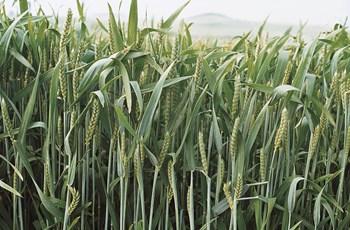
Around 40% of the planned winter cereal area in the west country ultimately got drilled and then survived through to the spring. There is a wide range of crops – some wheat was drilled in September, while others have only been in the ground a month.
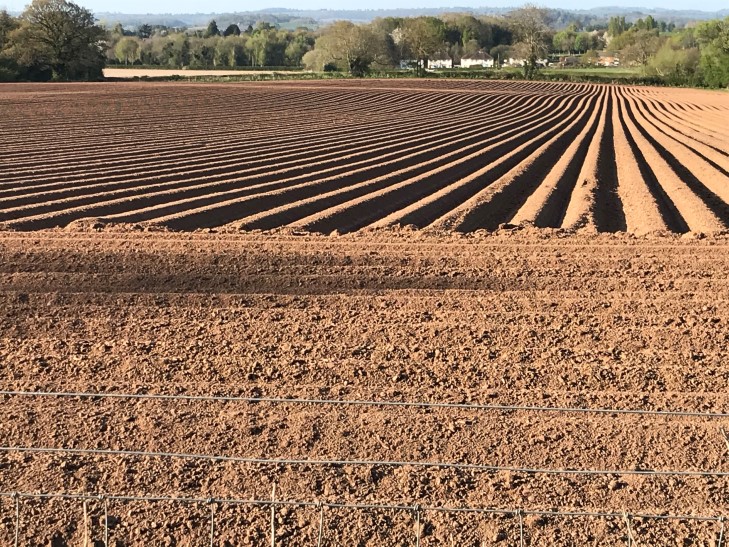
Spring planting has driven on at pace, with spring cereals, potatoes and maize all being planted in the past month.
The priority as I write this just after Easter is to finish herbicide programmes. Try not to over-complicate mixes and avoid applying to stressed crops, if possible. Both potentially can check growth and exacerbate problems.
If you’ve rolled late-drilled crops, it is important to let the crop heal from the effects of rolling before applying any products, as that can reduce crop safety also.
As usual in the west, it is easy to find Septoria in wheat crops, while there are also reports of yellow rust on both the usual and some less usual varieties. The latter could be on juvenile plants, and it is not always easy to know when adult resistance will kick-in. The T0 sprays being applied around Easter should keep it in check. Remember for yellow rust timing is critical – don’t leave more than three weeks between sprays.
As we move towards the end of April, take the time to identify leaf 3 accurately for T1 sprays. Don’t be fooled into thinking it will coincide neatly with GS32. This year, even more than others, it might happen before that, especially in backward crops.
Septoria risk should determine product choice at T1. Always include a multi-site at the timing. In lower risk situations, Aviator (bixafen + prothioconazole) at 0.8 L/ha should suffice in addition, increasing to 1.0 L/ha as risk increases, or switching to Ascra (bixafen + fluopyram + prothioconazole) at 1.0 L/ha. Both products are good all-rounders covering all the key disease threats at the timing.
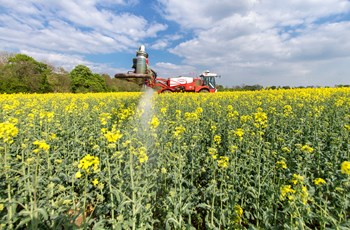
Oilseed rape crops in the region are approaching flowering. While some look patchy, if you’ve managed to get it this far, then it is likely to be worth protecting, especially against Sclerotinia if it is damp around petal drop. It is also worth topping up light leaf spot control in flowering sprays – over 90% of SpotCheck samples in March had light leaf spot infections – so consider using a fungicide with activity against both diseases, such as Aviator at 0.75 L/ha around mid-flowering.
A lot of spring cereals went into moisture and emerged quickly. Hopefully growers will have used pre-emergence herbicides to keep the crop clean from the beginning.
If you’re intending to do two disease control sprays in spring barley then the first one ideally needs to be no later than late tillering, otherwise there will be only a short interval until the second spray, which is the key timing in spring barley crops.
While one spray is possible in spring barley, consider the risk from net blotch in particular. One spray will only give four weeks protection, and it is as difficult to control disease curatively in barley as in wheat, so if it is already infected before spraying then it might be too late.
With the cut off of 20 May for using chlorothalonil potentially being before spring barley T2s will be applied, it will be important to reduce stress in these crops, and that will include avoiding other diseases getting into the crop.

Recently emerged spring barley crop

Recently planted potatoes

Blackgrass plant treated with Atlantis OD