Fastest developing OSR hybrids cope better with flea beetle
The fastest-developing oilseed rape hybrids coped better with cabbage stem flea beetle than other hybrid or conventional varieties last season, reveals the most reliable independent data on farm performance.
The fastest-developing oilseed rape hybrids coped better with cabbage stem flea beetle than other hybrid or conventional varieties last season, reveals the most reliable independent data on farm performance.
The industry-leading, 400-strong Kleffmann Group WOSR AMIS® farmer panel, carefully selected to be representative of British growers, obtained information on more than 700 oilseed rape crops of 84 different varieties in 2018/19.
Two-thirds of harvested crops suffered notable pest damage, but the majority (59%) recovered reasonably or very well, delivering gross outputs 0.76t/ha higher than the 10% that recovered poorly.
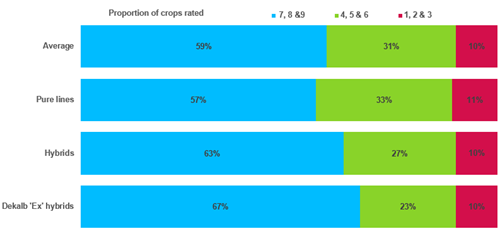
Hybrids recovered noticeably better than conventional varieties to show an average 0.17t/ha gross output advantage at harvest, with the fastest-developing, most-robust Dekalb ‘Ex’ hybrids recovering best of all (Figure 1) to deliver the highest average gross output at 3.98 t/ha.
Figure 1: Where you suffered pest damage last year, how did your crops recover from it on a scale of 1-9? (where 1 = very poorly and 9 = very well)
While little or no differences were evident between the various establishment systems employed, hybrid recovery rates were consistently better across plough-based, subsoiler seeding and direct drilling regimes.
Hybrids also recovered from damage markedly better than conventionally-bred varieties across all sowing dates – from the first half of August to September. Not surprisingly then, growers were noticeably more satisfied with their hybrid crops than conventionally-bred ones, with Dekalb ‘Ex’ hybrids rated the most highly – 79% of crops scoring 7 or more on the 1-9 scale.
Overall satisfaction levels from crops sown in the both halves of August were clearly higher than those sown in September, although there was no discernible difference in gross output between earlier or later sowing. This may reflect better moisture conditions as well as lower levels of larval damage from later drilling.
Underlining their abilities, hybrids showed a slight but consistent gross output edge over conventionally-bred varieties, regardless of sowing date.
We would like to use optional cookies to better understand your use of this website in order to improve our website. Your consent also covers the transfer of your Personal Data in unsafe third countries, especially the U.S., involving the risk that public authorities may access your Personal Data for surveillance and other purposes without effective remedies. Detailed information about the use of strictly necessary cookies, which are essential to browse this website, and optional cookies, which you can reject or accept below, and how you can manage or withdraw your consent at any time can be found in our Privacy Statement