2018 sugar beet profits better than expected, says grower Richard Styles

Posted 8 years ago
17/04/2018

Adding sugar beet to your rotation can help with black-grass control
Good establishment is critical – preserving moisture ahead of drilling is key
After a 27-year break, Richard Styles is again growing sugar beet on his heavy land farm near Debenham, Suffolk. Encouragingly, the 2017-18 crop has performed admirably, and aside from an eight-week drought after drilling which threatened an otherwise good establishment, he has no regrets about growing the crop.
“It has done everything we wanted it to. We budgeted for a yield of 90t/ha (adjusted) and, so far, the crop is averaging 104.8t/ha, so it is quite profitable. It has provided the opportunity to control black-grass we needed, and it has been lifted without undue damage to the soil structure,” he says.
His return to sugar beet was prompted by two issues:
The need for an alternative spring crop that would support black-grass control.
Improvements to beet loader design and advances in tyre technology which meant soil damage was no longer the threat it once was.
“Good soil structure on our heavy land is something I take seriously, as damage has lasting effects and can be hard to rectify. Similarly, I have seen the impact high black-grass populations can have on business profitability, and was determined not to let that happen to me. Our situation is not as bad as some, but that is not an excuse to be complacent,” says Mr Styles.
Lifting began at the end of October and will be completed as soon as ground conditions allow. The early lifted crop was followed with winter wheat, while no decision has been made as to what spring crop will be drilled.
“There is a big area of spring barley being grown in England, and with prices under pressure it is not so appealing. Given the area to be sown is reasonably small at 8ha, canary seed is a consideration with a ready market for the product.”
Black-grass was controlled through clethodim and the use of ethofumesate, either as a straight or in a three-way combination with desmedipham and phenmedipham for added broad-leaved weed control.
“The prolonged dry weather after drilling led to patchy establishment, while crop safety concerns led to some herbicide applications being delayed longer than is ideal. Fat-hen was a weed that we wrestled with, but I regard any crop with no black-grass in at harvest as a success,” he says.
Although the wet summer has helped push average yields for all crops, Mr Styles has revised his ground preparation strategy for next year to preserve moisture ahead of drilling.
“Good establishment is critical, and I am keen to avoid over-working the ground ahead of drilling to preserve moisture. In contrast to last season we have ploughed and pressed the land ahead of the winter, whereas we left the furrows intact in 2016. Hopefully, we can then create a good seedbed without losing much moisture,” he explains.
Fortunately, disease control was straight forward, with a clean crop meaning the first fungicide could be delayed until early August with the second application applied at the end of the month.
With another three years to run on his contract with British Sugar, he is hopeful that this year’s success can be maintained, though he finds the loss of neonicotinoid seed treatments worrying.
“I’m not sure how much protection we can realistically deliver against mangold-fly and their progeny, leaf miners, without the use of neonicotinoid seed treatments. It will certainly be more challenging, and what we use to achieve it will potentially be more damaging to the environment than the product they are replacing,” says Mr Styles.

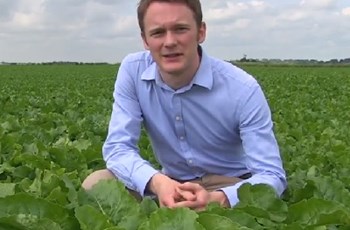
Richard Styles says sugar beet has delivered all that he could have hoped for this season
Receive regular in-season Bayer Sugar Beet Crop Focus emails to stay up-to-date on sugar beet agronomy advice