Consumer interest the basis for horticulture revival

Posted 4 years ago
30/03/2022
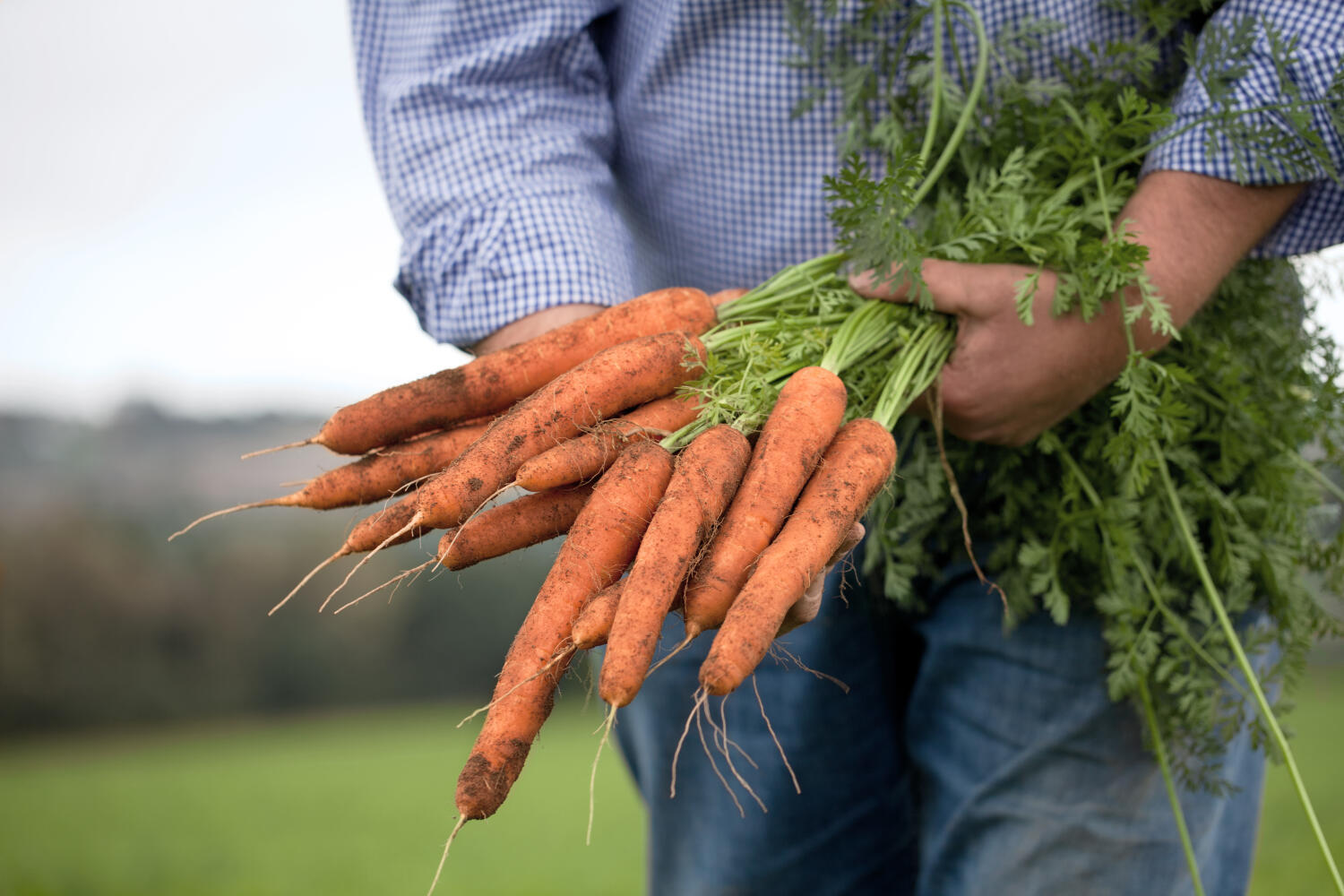
Fruit and vegetables have rarely enjoyed such widespread and prolonged consumer promotion. The challenge confronting growers is how to exploit the opportunities this may bring to improve profitability and productivity.
The latest initiative intent on promoting the consumption of fresh vegetables is Veg Power which seeks to raise their appeal to school-age children by presenting vegetables as fun to eat.
With the backing of many celebrities and people of influence, the campaign has the simple objective of encouraging kids to eat vegetables by cooking, blending and transforming them into something enjoyable and healthy to eat.
The Veg Power campaign seeks to build on the foundations laid by the “Five- a-day” programme but goes beyond promoting the health attributes of fresh vegetables to reach the kids whose parents have given up on trying to get their children to eat five portions of fruit or vegetables a day.
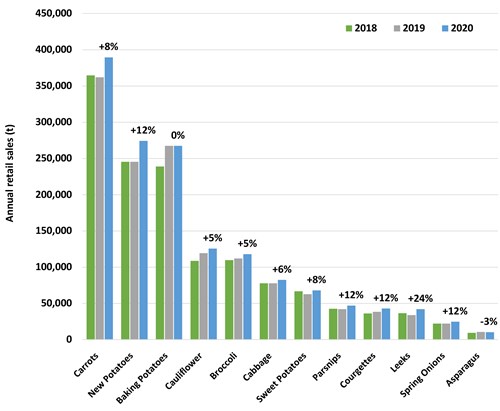
For all their good intentions, however, the single biggest promoter of fresh vegetables has been the coronavirus pandemic. During 2020, the first year of the pandemic, retail sales of fresh produce (not including fruit) increased by 6% on the previous year.
Ware potatoes are the single biggest selling vegetable accounting for more than 10% of retail sales in 2020 and roughly twice the volume of the next most popular vegetable, carrots.
As chart 1 shows, aside from potatoes, big gains were posted by leeks (up 24%) while carrots were up 8% and asparagus was the big loser, down 3%.
Source: Kantar
The statistics, compiled by grocery analysts Kantar, exclude the out-of-home sector such as restaurants, pubs and take-aways, but other data highlight the importance of convenience in promoting consumption: in the first six months of lockdown 2020, retail sales of frozen chips rose 16% and sales of crisps and other potato snacks, 17%, reported AHDB Potatoes.
It remains to be seen if other behavioural changes, such as the growing consumer interest in low-carbon production systems, which has the potential to drive demand for home-grown produce, are to the long-term benefit of the industry.
Higher demand does not always translate into higher market prices if demand is met through imports. More significant will be the production constraints facing growers through tighter environmental regulation, the loss of plant protection products and the increasing cost of energy and other inputs and tougher retailer requirements.
For all the work of Jamie Oliver and other well-intentioned people, the harsh reality is that promoting vegetable consumption amongst society will do little to address the productivity challenges facing the industry. The Veg Power campaign, and others like it, are entirely laudable, but the industry needs to improve the efficiency with which these vegetables are produced if growers are to improve both business resilience and profitability.
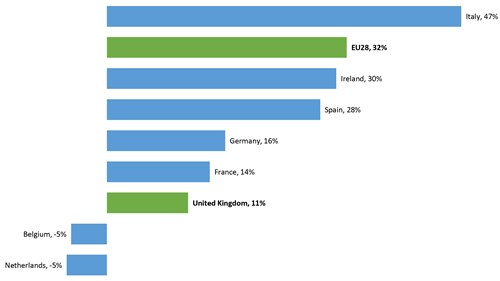
Chart 2 highlights the productivity gap facing farmers in the UK compared with their European counterparts. The adoption of data driven decision support systems will go some way to addressing productivity issues through more efficient use of inputs.
Source: Eurostat
Other technological advances intent on reducing reliance on labour, improving soil health and increasing water-use efficiency will also be central to marking progress.
There is no one reason for the poor productivity situation. Some are structural and technical, others behavioural and regulatory, but what is perhaps most telling is that there is as much variation within a sector as there is between [sectors], explains John Giles, divisional director for Promar International, a firm of consultants.
“In many cases the issues are not new, but the effect has been compounded by Brexit and the Covid pandemic,” Mr Giles says.
Even within the higher value sectors of the industry however, the UK could do better. A study by the Copenhagen Business School found that productivity within the UK horticulture sector could be improved by 13% if readily available technology were adopted.
“In some sectors, productivity gains have been hindered by the lack of automation or other technologies while in others there is so much choice that it can be difficult to know what machine, process or system will best meet your needs now and in the future,” he says.
International comparisons may present UK agriculture and horticulture in a poor light, but there is reason to be optimistic, believes Mr Giles.
“The National Food Strategy led by Henry Dimbleby is perhaps an example that government is establishing the foundations of a policy. It is aspirational in its content, and we should not be shy of lofty ambitions, but the delivery will be key. The Agriculture Act too gives an indication of how government intends to shape the future of our industry and improve productivity, but it will take time, investment, reform and the adoption of science and technology, for real progress to be made.”
“There’s not one country we should seek to follow. Making progress in productivity is about more than just adopting new systems. There needs to be a change of mindset too,” Mr Giles says.
“The UK needs to blend the promotional funding of the Irish, the R&D resources of the Netherlands, especially its public sector expertise such as Wageningen University & Research, the sheer ingenuity of the Israelis, the positive outlook and ‘make it happen’ attitude of the Peruvians and Chileans, and the market provenance and supply chain agility of the UK.
“There are elements to the UK industry that are world-class, and we are fortunate to have a discerning customer base that appreciates product differentiation, but we need to build on this to develop the rest of the industry while using our unique selling points as a source of strength.
“We should not be scared by this challenge. Just two to three decades ago, British agriculture was seen as a problem with disasters such as BSE, salmonella, and foot-and-mouth, yet it has come through this to be seen as a positive attribute. Everyone from Waitrose and M&S to Lidl and Aldi use their support for British agriculture as an endorsement of their brand because it resonates with consumers. The industry should take heart from this while leveraging its position,” he says.