YEN highlights interesting OSR establishment differences

Posted 5 years ago
17/03/2021

Greater use of hybrid varieties, narrower row widths and later August sowing were all significantly associated with better establishment last autumn, according to early results from this season’s Oilseed YEN.
As part of the competition’s particular 2020/21 focus on this critical aspect of OSR success, YEN’s first-ever Establishment Beauty Contest judged 48 crop entries across the country for establishment rate, evenness of plant spacing, uniformity of plant size, plant vigour, plant health and absence of weeds.
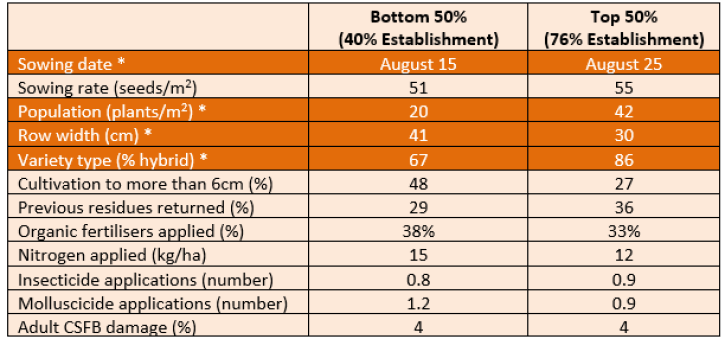
“Establishment rates varied from an average of 76% for the top-scoring half of the entries to 40% for the bottom-scoring half,” reports ADAS crop physiologist, Dr Sarah Kendall. “Out of the various elements of establishment practice recorded as part of our ‘contest’, analysis revealed statistically significant associations with sowing date, row width and variety type.
“On average the crops establishing better last autumn were sown 10 days later than those doing less well, in 30cm rather than 41cm rows, and 86% of them were hybrids against 67% otherwise.
“We also saw a trend towards less cultivation and a slightly greater emphasis on returning previous crop residues with the better-establishing crops. Otherwise, there were few detectable management differences between the two groups of crops (Table).
Table: Oilseed YEN Establishment Beauty Contest 2020 Results
|
|
* Statistically significant association
While the sample size is relatively small, establishment conditions were generally more favourable last autumn and such associations are far from definite causations, they do give some useful food for OSR management thought.
They underline, for instance, that sowing in the right way towards the end of August may continue to be the best option for many – depending, of course, on CSFB pressure and most crucially, available moisture. As ADAS has found in previous studies, they also show wide rows can be harmful if seed rates are not adjusted to prevent too much inter-row plant competition. And they suggest that hybrid varieties could well have a valuable edge over conventional ones in the vigour with which they establish.