Six key factors to assess OSR crops this spring

Posted 5 years ago
16/02/2021

OSR growers should look beyond Green Area Index with simple traffic light assessments based on six key factors this spring to make the most of crops coming out of another very wet winter varying widely in their growth and risks from flea beetle larvae.
This is the advice of ADAS crop physiologist, Dr Sarah Kendall and Bayer technical manager, Darren Adkins to ensure crops are managed as closely as possible to their actual potential for the most reliable returns.
“We have a real mixed bag of crops this season,” reports Dr Kendall. “Some are thick and well-developed while others are small and backwards. Generally, decent moisture conditions following drilling meant noticeably better establishment than last season with less visible adult cabbage stem flea beetle damage in most cases. So, overall, we’re cautiously optimistic about their potential.
“However, ADAS monitoring across the country shows adult CSFB populations were similar to the last few years in many areas, so larval pressure is the great unknown. We do know, though, that many growers opted for earlier drilling and that early sowing tends to mean higher numbers of larvae.
“Once again then there’s a real danger of good-looking crops going backwards rapidly in the spring, raising serious questions over their potential; especially so after another root-restricting winter, and should we have a repeat of last year’s spring and early summer drought.
“Balanced against the threat of larval damage, oilseed rape has tremendous powers of recovery,” she observes. “So, it’s as important not to write off crops that could deliver reasonable returns as it is not to hang on to those unlikely to do so.
“For the best returns we have to look beyond GAIs so we can match each crop’s agronomy to its realistic potential. What we see on the surface is far from the full story.”
Based on their experience, Dr Kendall and Mr Adkins regard six key questions as central to the best winter oilseed rape management decision-making this spring.
They point out that oilseed rape with a root collar greater than 10mm, a tap root of over 10-15cm and with many fibrous roots in the top 10cm will really help the crop against further challenges. Equally, the crop’s evenness across the field is at least as important in judging its potential than average plant population.
With both winter waterlogging and summer drought known to have a major effect on yield, the extent to which crops have sat in water over-winter and the likelihood that the ground will suffer from drought in May and June are further key considerations here.
“Also important is the earliness and speed of crop re-growth in the spring,” Mr Adkins stresses. “Dekalb work with trials badly-affected by CSFB shows hybrids like DK Extremus, DK Expedient, DK Expectation and DK Exstar that are relatively early to grow after the winter lose fewer main stems and have less stunting than later-developing hybrids or conventional varieties. And if they are a little later to start growing they need to be as quick out of the blocks as DK Exsteel and DK Expansion.
“Finally, of course, we need to open-up some stems to see exactly how many flea beetle larvae crops are carrying. It’s really surprising how well those that are better rooted and more even, come through the winter without serious waterlogging and are in ground that seldom suffers badly from early summer drought can deal with quite substantial burdens of larvae; especially if they are inherently earlier into their spring growth. “On the other hand, crops that are less well-placed in these respects can suffer really badly from surprisingly few larvae.”
Using the same approach proving so valuable in managing problem grassweeds in recent years, Mr Adkins and Dr Kendall advise growers to use a simple field-by-field traffic light rating system based on these key characteristics to guide their spring agronomy (Figure).
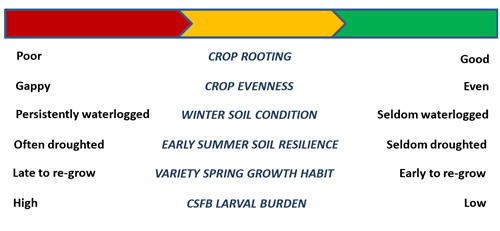
Figure: Traffic Light OSR Assessment Regime
This will objectively separate out crops that aren’t worth keeping from those that are likely reward further investment. And, most importantly, ensure the level of attention and inputs each crop receives is warranted by its actual potential.
Crops that come-up red on assessment are most unlikely to produce the 3t/ha essential to justify further investment on most farms, they point out. So, they strongly advise biting the bullet and getting rid of them early enough to establish a replacement crop this spring.
“With all the emotion – not to mention cost – put into getting them this far, it’s tempting to hang onto crops in hope,” says Mr Adkins. “But the longer you do so, the more good money you throw after bad, and the less opportunity you have for replacing them with spring crops able to recoup the costs of the OSR as well as their own.”
The decision is equally straight-forward with crops assessed as green. With the right management they have plenty enough potential to exceed 4t/ha, generating better margins than any other cereal break.
Here the specialists recommend using all the established elements of best OSR management practice to make the most of that potential; including fertilising for the optimum GAI of 3.5 at flowering; managing for the most efficient light-intercepting canopy; and timely crop protection to maximise green leaf area survival for the best grain filling.
“Of course, it’s the amber-coded fields that demand the most careful management,” Dr Kendall agrees. “The key must be to get the best balance between what you spend on the crop and what it’s likely to deliver. We know many 3.5t/ha crops can produce reasonable margins. But only if they are managed for that potential rather than to the ‘standard recipe’.
“In particular, it’s important to get the basics of fertilisation and crop protection right, avoiding ‘insurance agronomy’. Equally, you should be prepared to be as flexible as you can with inputs depending on precise crop condition and the weather.
“Crops with lower GAIs will clearly need more early N than those with higher ones. But increasing the number of splits gives you more opportunity to adjust applications to actual need and conditions as they develop.
Matching your spray programme as closely as you can to crop requirements is crucial too,” adds Mr Adkins. “There are lots of things you can do to flex your fungicide programme, providing you know what level of light leaf spot threat you’re facing. Which is where the free Spot Check service we run with ADAS is so valuable.
“Base pollen beetle spray decision-making even more carefully than usual on thresholds too. As these are significantly higher than with conventional varieties grown at higher plant populations, most hybrids are unlikely to need treatment unless the pressure is much more intense than it has been in recent years. All the more so if the crop is racing into flowering.
“You should also think particularly carefully about whether a second sclerotinia treatment is warranted. A single well-timed mid-flowering spray with good activity and persistency should be sufficient in most cases unless flowering is really extended.
“The costs of including an insecticide or another pass with the sprayer aren’t massive on their own, but they all add-up when you’re watching the pennies as closely as you need to in amber-coded crops.”
Do keep monitoring this year’s crops through to and beyond harvest, the agronomists advise. Comparing actual yields and profitability against your spring assessments is the best way to see how successful you have been in your decision-making. That way you can fine-tune your future OSR management decisions to real experience under your own conditions. Which has to be best way of continuing to make the most of what remains the best cereal break.