Defending glyphosate and investing in the next generation of chemicals
Several important active ingredients have been lost through new interpretations of European regulations, but Bayer is taking a leading role to defend one of the UK’s most important: glyphosate.
2017 (12 Dec): European Commission reauthorised glyphosate for five years
2019 (Mar): Assessment Group on Glyphosate (AGG) established to assess application dossier and prepare draft report for EFSA
2019 (15 Dec): Deadline for submitting renewal application
2021: EFSA to review AGG report
2022 (15 Dec): Current glyphosate approval expires
It is becoming harder and more expensive for agrochemical manufacturers to get products approved through increasingly unpredictable European regulations.
Those criteria have also resulted in many important actives being consigned to the history books after failing to get re-registered.
Chlorothalonil’s withdrawal from 2020 is the latest high-profile example from the fungicide armoury, glyphosate’s future still dominates the herbicide sector, while another cornerstone of weed control, flufenacet, is also due for renewal soon.
Defending glyphosate
The European Commission’s reapproval of glyphosate for another five years in 2017 provided temporary relief to those fearing the worst, but the comparatively short extension and huge volume of data required by regulators mean work is well underway towards securing its availability beyond 2022.
Bayer’s Head of Regulatory Science, Janet Williams, says manufacturers must submit a renewal application for any active ingredient to the relevant EU authorities three years before the approval expires:
“In the case of glyphosate, this means a deadline of 15 December 2019, while we are still renewing all the products in the Member States from the previous active substance renewal.”
Given the multitude of glyphosate-based products on the market and the huge amount of work required in the re-approval process, we are taking a leading role alongside other European manufacturers in the combined Glyphosate Task Force (GTF) to submit a joint application for glyphosate’s renewal.
“The regulatory environment is extremely challenging as guidelines are constantly changing and the hurdles getting higher. Manufacturers have to conduct more studies and provide extra data at considerable cost every time an active substance is due for renewal or a new one is developed,” Mrs Williams says.
However, the technical data requirements of re-approval are only half the story in an increasingly political environment.
“The problem with glyphosate is there’s a big disconnect between the political debate and the scientific evidence,” Bayer’s Mark Buckingham says.
“Despite scientific confidence in glyphosate from many different regulatory agencies, EU politicians still only granted a five-year renewal when it could have been up to 15 years.
“The political pressure and public debate might make some people think glyphosate is facing a sunset, but that’s not how we see it.
“We have full confidence in the science behind glyphosate and it remains vitally important to many farming systems. Losing it would force many farmers towards greater use of cultivations. That may reduce chemical inputs, but would increase fuel use and soil disturbance, which is detrimental to carbon emissions and soil health.”
Funding the future
It typically takes manufacturers around nine years and costs some £350m to compile the dossier of safety data and other information required to register a new active substance, while significant additional costs are incurred during the periodic re-registration process.
“Lead manufacturers like Bayer have to fully understand the complex dossier of information that goes with an active substance and are the ones investing in the essential research & development to get products reapproved,” Mrs Williams says.
Indeed, innovative new coformulations of glyphosate are one particular way the active’s future could be secured, Mr Buckingham believes. A new formulation of Roundup ProVantage, for example, will be available in around two years and promises greater efficacy and reliability compared with cheaper generic glyphosate formulations.
Screening is also underway for other ‘next generation’ candidates, he notes. “A big advantage of Monsanto joining the Bayer family was the ability to pool our knowledge of formulations and innovate. “We are constantly looking at co-formulations, which are the best option for resistance management. But they raise other issues as you have to get multiple actives approved and if one is ever withdrawn, that product cannot be used.”
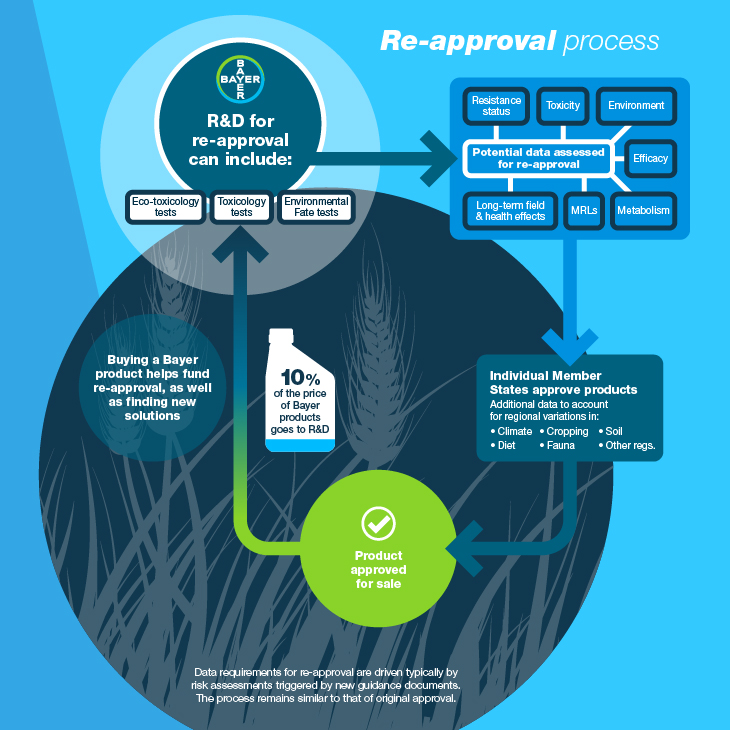
The approval process
EU authorisation of crop protection products aims to protect human and environmental health & safety and is governed by Regulation 1107/2009, while European Directive 2009/128/EC applies to product use.
Initial authorisation is in two stages:
1. EU approval of the active substance, allowing it to join the EU list of approved products (formerly known as Annex I of Directive 91/414)
2. Authorisation of all products containing that active substance by individual member states (in the UK this is done by the Chemicals Regulation Division (CRD) of the HSE).
Active substances are usually approved for 5, 7, 10 or 15 years, but can be reviewed at any time if there is new scientific evidence. Authorisation of any active substance requires specific tests on its physical and chemical properties, plus data on toxicity, metabolism, food residues, environment, ecotoxicology, and efficacy.
There are also long-term field and health studies to monitor possible effects of product exposure, while data must also be provided for EU authorities to set Maximum Residue Levels (MRL).
The renewal process requires manufacturers to update much of this information to account for any changes to scientific evidence, regulatory guidelines or legislative criteria, which always makes re-approval harder and more costly, Mrs Williams says.
This blog is based on an article from the autumn ‘19 issue of Crop Focus magazine. The magazine is packed full of insight, advice and research from the world of arable farming to help you grow the most profitable crops possible. Over 90% of readers find Crop Focus an interesting read – it’s free to subscribe so sign-up today!
We would like to use optional cookies to better understand your use of this website in order to improve our website. Your consent also covers the transfer of your Personal Data in unsafe third countries, especially the U.S., involving the risk that public authorities may access your Personal Data for surveillance and other purposes without effective remedies. Detailed information about the use of strictly necessary cookies, which are essential to browse this website, and optional cookies, which you can reject or accept below, and how you can manage or withdraw your consent at any time can be found in our Privacy Statement