The UK’s Agricultural sector has a huge challenge with Lantra telling me the sector needs 600,000 new entrants with land skills by 2020. Agritech is part of this and is one of the key sectors in the Government's industrial strategy, but despite all the great initiatives going on, are Generation Z aware of this? And in the numbers required?
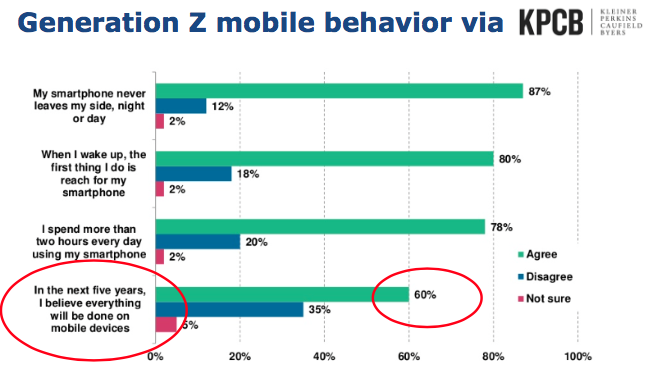
Generation Z represents those born between 1996 -2010 and they stand out as the first generation to have lived with the internet from birth and have a “mobile first” mentality as the KPCB report below highlights.
My interest in the sector started four years ago after watching BBC2’s CountryFile report on the sectors skills crisis. I thought we could potentially help by embedding careers information into our STEM GCSE educational applications and create FREE unique resources that blend curriculum, careers and company information. I am pleased to say we achieved that and over the last 18 months, we have helped 10,000+ students, with the kind support from the likes of National Grid and Bayer. Recent support from The Royal Society of Biology will help further, but far more support and partners will be required if we are going to have a big impact.
The Challenges
The Sector Challenges
As many as 600,000 new entrants are required yet the apprenticeship levy introduced in May 2017, will create even more competition for talent going forward.
How to educate teachers, how to inspire, engage and attract Generation Z and how to embrace the changes in technology will be significant challenges moving forward.
The School Challenges
Getting more students to take STEM subjects and to get schools to promote all pathways i.e. schools with 6th forms want everyone to do A levels as that is how they are funded!
The Technology Challenges
We all know technology moves at a pace but how fast? Well, it took 45 years for 25% of the population to adopt electricity, the telephone 35 years, television 25 years, personal computers 17 years but only four years for smartphones! This speed of adoption has even shocked world leading technology experts like KCPB, and I implore everyone to absorb their annual internet trend presentations, as it will give your business a strategic edge.
Because of this trend, Google changed its algorithm in 2015 and now ranks mobile friendly websites higher - see Google’s Mobilegeddon.
Generation Z has also been gamified since birth causing attention spans to drop from 12 to 8 seconds over the last few years, and they live in a mobile/video and social media first world out of school.
The Solutions
From what I have learnt over the last five years I think there are seven parallel solutions to the challenges;
- Better careers advice embedded into the curriculum at schools and the promotion of all potential pathways
- Inspirational company information that is simple to understand for young people
- Businesses working with schools to provide work encounters
- CPD for teachers so they understand the local labour market
- Apprenticeships
- Better vocational qualifications
- Opportunities to embrace the latest technology
1. Careers Advice in schools
The agricultural industry needs to create emotionally engaging resources that all stakeholders can find and use with ease. I don’t know about you, but as of yet I haven’t spoken to a single person of any age, who has had anything good to say about careers advice at school but why is that? The answer is not simple, but I believe the key issue is students get too much information and very little inspiration.
The new National Land Based College is working on bringing everyone together, so hopefully, they will be co-ordinating what works and sharing best practice in this area.
2. Inspirational company information
I guess it comes as no surprise, but I haven’t found a single business website as yet that would be of any interest to young people.
Huge CSR budgets are being spent by corporations but very little it appears on simple resources that explain why what and how they do what they do! So maybe testing a different approach would be a good idea?
My conclusion is that most sectors are not inspiring young people but why? If teenagers were our customers, we would be focused on how we inspire and engage them. I believe the answer is to sell the future not what everyone does today.
3. Schools and businesses working together
The Government funded careers services were closed down in 2012, and a new service, The Careers and Enterprise Company was launched in 2014. Their goal is to help drive student employer encounters, as the research shows that students who have four or more such encounters are 86% less likely to be unemployed or not in education and training.
I agree that this is key, so how many companies in the sector are involved with TC&EC? Or even aware of it? Or are working with schools like Thornbury school, who have a brilliant program to connect businesses and students.
4. Local CPD for teachers
Time and budget is the biggest issue for teachers, but I am sure the sector could make things easier for them. What is missing apart from the careers resources is the local and national labour market information, i.e., the Big Data on what skills are required, where they are needed and the salaries on offer. Some of this data is available via LMIforAll, but can be very confusing and inaccurate unless you understand how it was created. Other services are available which colleges use to design courses, but hopefully, this will open up to all stakeholders sooner rather than later.
5. Apprenticeships
Many companies may not like it but the apprenticeship levy introduced in April this year could not have come at a better time; however it does mean competition for apprentices is going to be fierce, as every sector has created schemes. All the Land based apprenticeships are close to completion but how is the agricultural sector going to promote them and stand out from the crowd?
6. Better vocational qualifications
The government has known for some time that good vocational qualifications are essential if we are going to close the skills gap and the T-Levels[JPL1] introduced in the budget, along with apprenticeships should see us have a world class system going forward.
7. Embrace the latest technology
Google changed its algorithm in 2015 which ranks mobile friendly websites higher see Google’s Mobilegeddon so it is important all stakeholders ensure their websites are mobile friendly. Indeed, you can test them yourselves here.
This year’s report from Deloitte confirmed that “The UK has never been more addicted to smartphones” and Childwise says “94% of the teens have a smartphone and spend more than 4 hours a day on them” so shouldn’t the agricultural industry embrace the technology they are connected to 24x7?
Video is also a key way they like to absorb content, which is why Mark Zuckerberg of Facebook has implemented a video first[JPL2] strategy, so shouldn’t the sector embrace these huge trends when attracting young people?
As a profit-for-purpose social enterprise, we can help in this area: we have a flexible cost effective mobile learning solution; we are passionate about helping to fix the skills crisis and inspire the next generations; and any clients and partners would be part of our existing application network for young people which includes our STEM GCSE applications.
An example of what we are doing is this FREE GCSE Biology App available via http://impartiq.co.uk, is written by the leading textbook author Ann Fullick, which will help students grasp the subject while introducing them to careers ideas and companies.

Moving forward, new 5G mobile networks will fundamentally alter the way we live, work, and relate to one another. In its scale, scope, and complexity, the transformation to the 4th industrial revolution, as they are calling it, will be unlike anything humankind has experienced. .
The adoption of social media is even faster than smartphones and is another key area for everybody to embrace, but there is not time in this post to expand beyond saying it should be an important part of any outreach effort and key influencer marketing could really help.
Summary
The sector is doing many good things but what has happened with the likes of the 2013/14 Horticulture matters report? And who is responsible for monitoring and publishing the impact of any initiatives like Brightcrop, Grow Careers or Younghort?
On a personal level, it appears most sectors are keeping the exciting stories behind closed doors, which I find odd as Generation Z make up the future talent pool and they will be the ones bringing the products and services to market, not what we are doing today. So shouldn’t we be selling the future to them via the technology they use 24x7?
I believe it is critical that we all inspire not just inform future generations otherwise UK plc will continue to have millions of young people go to college and university without any idea of what they want to do, wasting not only their money but also impacting on the success of the UK as a whole.
I am in no doubt the UK has exciting opportunities for young people but I do feel all sectors need to re-think how they communicate and fast.