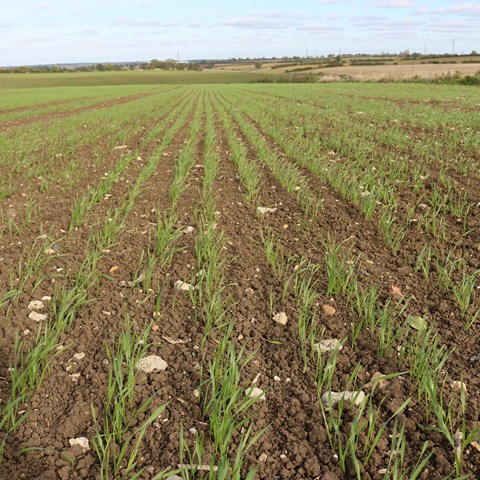
What’s happening in fields across the Midlands this October?
Ben Giles gives an update on oilseed rape crops and offers some advice on optimising blackgrass control in winter wheat this autumn

Posted 9 years ago
11/10/2017

Ben Giles gives an update on oilseed rape crops and offers some advice on optimising blackgrass control in winter wheat this autumn
This month’s update includes information on:
As most oilseed rape crops in this area are drilled into areas of potential high flea beetle pressure, it dictates when growers will drill. This year there were some crops that went in very early and others held off to avoid peak migration, with the worst damage in crops drilled in mid-August, after which it warmed up and flea beetle went mad.
Early-sown crops are now well away and some could require an autumn plant growth regulator (PGR), while the later stuff has come through and is generally growing well. There is Phoma out there and where crops are small, they will be more susceptible to the development of stem canker later in the season and may need a fungicide soon. Where you have 8 true leaves the size of dinner plates, there isn’t the same concern.
Variety will also influence fungicide strategy and where you have Phoma resistance scores of 7 or above, an early spray might not be needed and one big hit of Proline (prothioconazole) for Phoma and light leaf spot control mixed with Kerb (propyzamide) applications should see you through the winter.
One pest still to be mindful of now flea beetle pressure has died down is the peach potato aphid. If the temperatures stay mild, smaller crops may still need protection against turnip yellows virus infection. Biscaya (thiacloprid) or Plenum (pymetrozine) will give the best results.
Winter barley drilling is finished, but I’d say wheat is less than 20% drilled. If growers delayed another 10 days I’d be happy, particularly on heavier soils where black-grass is often worse. Beyond 17 October is where you see the real benefit from delayed drilling, but consider the trade off with yield and the weather conditions.
Where there is black-grass, it’s a question of how high you go with pre-emergence herbicide stacks versus crop safety. Growers need good results from the residual chemistry, as there is reduced Atlantis (mesosulfuron + iodosulfuron) efficacy in this area, so pre-emergence control must be maximised.
Programmes should be based on Liberator (flufenacet + diflufenican) often mixed with 2l/ha of Defy (prosulfocarb) . Avadex granules (tri-allate) are one thing you could consider using too, they have been a top performer here in recent seasons.
There may be the need to top up residual activity peri-emergence with another 120g of flufenacet where you can and pendimethalin is a good option too. Be mindful of loading up with extra diflufenican if looking to use later post-emergence options such as Hamlet (mesosulfuron + iodosulfuron + diflufenican).
Anything that can be done to improve seedbed quality will help maximise residual performance – assuming weather conditions allow, try to roll where you can. I would agree with the latest advice on pre-emergence applications. Use 200l/ha of water, slow down to less than 12kph, keep the boom low and use an appropriate nozzle to minimise drift but still give good soil coverage.